Showing posts with label effective living. Show all posts

Sunday, April 18, 2010

Don't start group discussions by sharing initial preferences

Flickr StreetFly JZ
http://www.flickr.com/photos/streetfly_jz/2764158005/
Don't start group discussions by sharing initial preferences

British Psychological Society's Research Digest blog

http://bps-research-digest.blogspot.com/2010/04/dont-start-group-discussions-by-sharing.html

When groups of people get together to make decisions, they often struggle to fulfil their potential. Part of the reason is that they tend to spend more time talking about information that everyone shares rather than learning fresh insights from each other. In a forthcoming paper, Andreas Mojzisch and Stefan Schulz-Hardt have uncovered a new reason groups so often make sub-optimal decisions. The researchers show that when a group of people begin a discussion by sharing their initial preferences, they subsequently devote less attention to the information brought to the table by each member, thus leading the group to fail to reach the optimal decision. The practical implications are clear - if you can, avoid beginning group decision-making sessions with the exchange of members' initial preferences.

I personally don't think groups should meet until they write up their own views in advance. I will strive to focus on the task of "devoting attention to the information brought to the table by each member", maybe the output of the first meeting should be nothing more or less than a summary of all the different viewpoints, and a rough ad-hoc synthesis of all the viewpoints into a whole (however inelegant). And "real" work begins at the SECOND meeting, in a manner where nothing can be swept under the rug, meaning no viewpoint can be discarded.

Enhanced by Zemanta

Monday, April 5, 2010

Procrastination and Falling in Love with Your Capacity to Really Fail

Characteristic hands-raised anjali greetingImage via Wikipedia

I had an unusual brainstorm on Easter weekend.  Before I continue, let me type out thoughts that help me get from an unproductive state to a productive state, and then I will get into new thoughts about procrastination.

I based all this on collecting failure modes.  As you run into difficulty, add the corrective thought to the list, that corrects the failure mode you just experienced in your life.  When the list gets too long and too unwieldy, just scrap the whole thing, and start with a fresh mind, because you are probably in a different place due to new habits of thoughts and actions and new life situations.

So, in my life, recently, I added these thoughts to a list that I force myself to contemplate when I am in a unproductive or incapable state.

The First Four:

Embrace Philosophical Security - this is the peace and security of the Stoic philosophers, such as found in Epictetus.  More than a lack of anxiety, it is a positive goal.

Embrace Epicurean Delight - In my mind it is taking enthralling happiness from the commonest of physical experiences, like a breath of morning air, or a sip of cold pure water, or grass felt by bare feet while morning rays hit your shoulders.

Embrace Graciousness - Tolerance - Accommodation - for other people and outside things, offer them all graciousness, tolerance, accommodation.  Easy to imagine the current Dalai Lama, Tenzin Gyatso, acting naturally in this manner.  Just copy that way of being

Embrace Being Informed by Honest Work - how wonderful to enter a situation being informed by honest work.  You can speak with understanding, assurance, and earned confidence.

Two More:

Is my current action or inaction in opposition to any conceivable personal hierarchy of values and goals? You have some intuitive knowledge of all possible effective hierarchies of goals and values, so kick-start yourself into a compatible action, if you find your current coping or distracting action/inaction is utterly incompatible.

Link happiness to growth & improvement, and vice-versa. You have the right to define happiness however you wish, and to call whatever you wish happiness, so why not make happiness synonymous with growth and improvement.

The Latest Two:

Allowing yourself to drift through life without active intention is poisonous, just as if you bit into the bulb of a large mercury thermometer. Do everything in your power to avoid the thieves of intention.

Procrastination is not success postponed - be serious - the habit of procrastination is already failure.  Bouts of procrastination are hammer blows on the coffin lid.  When you procrastinate, you demonstrate that you ARE a failure.  These are all demonstratively true from first principals; procrastination is just a name for a form of anxiety that helps you preserve your ego, because you are clinging to the idea of success being postponed.  So, if you have the habit of procrastination, you will eventually have a crash, and a humiliating blow to your station in life.  Your only task left is to make this crash as soft a landing as possible, and to hopefully raise the bottom to limit the extent of the drop in status.

OK, done.  The heaviest thoughts are about procrastination.

There are two viewpoints when it comes to desire, intention, values, and goals.  There is the personal + intimate + internal + subjective + 100% inclusive view where your stated future desires are taken at full face value.  There is also the economic view which is external + impersonal + objective + cohort statistical based, where your stated future desires are given zero weight.

Procrastinators will be seen as wildly different in the two views.  Objectively, the procrastinator has distraction, consumption, amusement, and numbing as their highest goals, mixed in with some self torture (anxiety about how success is being postponed) only to preserve ego and a positive self-image.  This is an extremely negative way to view a person under the spell of procrastination, but it can be defended as demonstratively objectively true.

Procrastination is the funeral ceremony of your aborted higher self, the higher self that had the ability to accomplish those higher goals.  It is the funeral ceremony because you have demonstrated no ability to fulfill those higher goals, because the creatures that can fulfill those higher goals have no time for procrastination.  If the desire truly was there, you would procrastinate on your procrastination, and just dive right into your work, like a fish flailing on land, when it finally splashes back into the water, is too busy swimming to take time to beach itself again.  Procrastination is the signal that your higher self, whatever embryonic form it managed to manifest, is now dead.

Action is based on habit, and personal desires are the genesis of new habits, or the genesis of self-flagellation to preserve ego.  If all your personal desires just prompt bouts of self-hatred because of procrastination, and never prompt simply throwing yourself into your work, what are those personal desires there for?

OK, we talked about two views: the intimate & personal or the economic.  Your expected outcome is most likely to be predicted by the economic.  The End.

Am I taking things too far?  I remember that I lost my religiosity because I focused too much on an intense commitment to perform all the duties of religious faith.  I overdid it, because it is not the job of the common believer to maintain that intense commitment; I took it too far, I used a partial commitment as an excuse to dispense with all commitment.  I have mixed feelings about this, because, on the one hand, I am being honest about having a false viewpoint about religion, and, on the other hand, I cannot "rewind" my mind back to that earlier state, and I cannot say that I would prefer to be a believer again.

OK, back to the issue at hand; am I taking things too far, by calling procrastination the nails on the coffin of a higher life goal or value?

I will have to try out this viewpoint for a few days.  I will do this... Really bring into mind the feeling of realizing that my higher life goals, that I have had as constant companions for all my life, must be set aside for moving forward with more down-to-earth issues, and concentrating on preparing myself for the day when I must submit to a humiliating loss of status, and disown a big part of my past ego.  It brings things into sharp focus, and it brings home how serious is the issue of losing intention to the distractions, vices of consumption, vices of cheap amusement, vices of self-numbing.

I like this, because I cannot think of anything more fundamental than acting under intention under a moral commitment.  Forget procrastination and anything I may be procrastinating, this concentrating on action under intention is the primary important issue.
Reblog this post [with Zemanta]

Wednesday, March 17, 2010

No conspiracies - everything you should worry about is in plain view

{{en|Truman White House reconstruction. Title:...Image via Wikipedia
Conspiracies are very uninteresting. I am supposed to worry about Bush and Cheney bringing down the Twin Towers, but everything that happened during the GWB White House years was exquisitely planned and published before the fact by the conservative thinkers and the Neo-Cons. Why do we have to act surprised that they did exactly what they told everyone they would do?

That the Republicans and Democrats are two different faces of the Corporatist Party is something they don't even bother to hide. It is like accusing a five year old of a conspiracy to steal from the cookie jar when the little dude doesn't even bother to wipe the chocolate mess and crumbs from his little face. Using the word "conspiracy" is absurd.

Conspiratorial thinking is just a roundabout way to absolve yourself from any responsibility for taking action. It is a way to claim that any constructive action is pointless because the Big Bad Scary Forces pull the strings from the shadows. Garbage. Little thoughts for pathetic little people.

The conspiracy you should worry about is the conspiracy inside you, that makes you settle for 2nd best, 3rd best, 4th best, etc, when you possess the power to do more. The light of *personal* *responsibility* makes all the conspiratorial shadows disappear.

Because you should be thinking less about the state of the White House, and more about how much time you spend helping your daughter with her homework, or how you can tell your wife that you love her in a way that is meaningful to her, or all the personal battles that actually mean something in a life. Frick conspiracies in the tushie. Yeah, I said it: Frick conspiracies in the tushie!
Reblog this post [with Zemanta]

Thursday, February 18, 2010

No right to the outcome, only a right to the work

Carpenter at work on Douglas Dam, Tennessee (T...Image by The Library of Congress via Flickr
Copying from my urinal journal...

I want to write about not having the right to the desired outcome - only having the right to the requisite work to reasonably expect that outcome.

So if you want to date a supermodel, and you plainly see that earning many millions of dollars per year will allow you to date a supermodel, then you have no right to the *outcome* of dating a supermodel, you only have the right to the *work* required so that you can reasonably expect to earn many millions of dollars per year.  And that is quite a bit of work of very high quality, to earn that much.

The desired outcome is only there to inform your choice and fuel your very early commitment, but after that you must rely on a moral drive that makes the full scope of work its own reward.

Or else you can expect only bitterness at the end, and tears.  Because the world cannot guarantee the outcome - you do not have to travel far to find someone who ran down a path that turned into a dead end pitfall at the very last moment.

The moral emotion that can do this can be developed by acting consistent with its presence.  "Fake it before you make it."  Activating the muscles actually grows the sympathetic thoughts, and then, after training, the thoughts then cause the activity itself.  So, act as if you already believe that the full scope of work is its own reward (and that amount of work may be staggering).  Act in accordance with the idea that the work is its own reward, and the moral emotion will be developed and that moral emotion will then drive the authentic action.
Reblog this post [with Zemanta]

Wednesday, February 17, 2010

Positive Things to Embrace, for Perspective for Choice

I noticed that in my post yesterday:

Before attempt Rational Living - First Cast Aside Anxiety, Irritation, Negative Judgement

positiveImage by sdminor81 via Flickr
was completely stated negatively!  I only mentioned what I wanted to avoid, which is exactly the worst way to go about changing your focus.

So, stated *positively* I have:

Before attempt Rational Living - First Embrace --
  • Philosophical Security
  • Epicurean Delight
  • Graciousness - Tolerance - Accommodation
  • Being Informed by Honest Work.
Embrace these before, as a prerequisite for attempting Rational Effective Living -- attempting --
  • analysis
  • decision
  • commitment
  • action
  • rinse & repeat.
In detail:

Embrace Philosophical Security - this is the peace and security of the Stoic philosophers, such as found in Epictetus
Show me someone who is sick, and yet happy; in danger, and yet happy; dying, and yet happy; exiled, and yet happy; disgraced, and yet happy.  Show him to me, for, by the gods, I long to see a Stoic.
http://www.knowledgereform.com/2010/02/17/stoic-advice-from-epictetus-on-the-art-of-living-part-2/
Embrace Epicurean Delight - http://en.wikipedia.org/wiki/Aponia
As with the other Hellenistic schools of philosophy, the Epicureans believed that the goal of human life is happiness. This was to be found in the tranquillity of spirit which resulted from aponia, suppression of physical pain, and ataraxia, elimination of mental disturbances.
In my mind it is taking enthralling happiness from the commonest of physical experiences, like a breath of morning air, or a sip of cold pure water.

Gracious/UngraciousImage by TheGiantVermin via Flickr
Embrace Graciousness - Tolerance - Accommodation - for other people and outside things, offer them all graciousness, tolerance, accommodation.

Embrace Being Informed by Honest Work - how wonderful to enter a situation being informed by honest work.  You can speak with understanding, assurance, and earned confidence.

I have a lot of practicing to do, to learn this skill!
Reblog this post [with Zemanta]

Tuesday, February 16, 2010

Before attempt Rational Living - First Cast Aside Anxiety, Irritation, Negative Judgement

Tu Na - RespiraçãoImage via Wikipedia
I was thinking, as I got into the car, that, as a prerequisite for attempting Rational Effective Living -- attempting analysis, decision, commitment, action, rinse & repeat -- I must rid myself in appearence and rid myself in substance of:
  • Anxiety
  • Irritation
  • Negative Judgment of Others or Outside Things
... stated this way because casting away these debilitating things in substance follows casting away these debilitating things in appearance.  The appearance of calm and centeredness leads to fundamental integrity to the core with calm and centeredness.

I don't know if this is fundamental to everyone, but, for myself, Anxiety, Irritation, and Negative Judgment puts me in an incapable state.  These are the only things standing in my way, usually, in holding fast to calm and centeredness.

Negative Judgment of myself should not be chronic, because that, also, would lead to an incapable state.  I can use negative judgment of myself as a trigger -- as a part of the Analysis step of Rational Effective Living, because it will inform decisions about how to take action to improve myself, with moral emotional energy to maintain commitment.

Light Bulb Teapot, Variation #6, 1984, fired c...Image by cliff1066™ via Flickr
So, I will practice the skill of interrupting incapable states, using psychological techniques and techniques about physicality, to rid myself of Anxiety, Irritation, and Negative Judgment of Other or Outside Things.  And, then, I have the Space to perform Analysis, Decision, Commitment, Action.
Reblog this post [with Zemanta]

I'm assumed to be the leader, I just want to nap

"Explain why you'd rather pave the path or walk in it?" I just want to nap. But I am assumed to be the leader, usually. Why?

WUHAN, CHINA - SEPTEMBER 20:  A Tibetan mastif...Image by Getty Images via Daylife
1) I am Tall and meaty. I am built like a fullback. People are lazy and assign leadership to the tallest guy around, because the top of his head is easy to track, even with bobbing and weaving. Follow that tall dude!

2) I am Very surly. I always have a poopie-face on, so people assign leadership to me, just so that they don't have to deal with my surly poopie-face when I shout down their attempt to give me an order. If I am shouting out orders, at least they get some relief when I eventually leave the room.

3) I am a Bullshit artist. I begin almost all my spoken sentences without any knowledge of my eventual point. I am a fount of infinite plausible bullshit.

4) I am the Child of an Alcoholic, so I can tolerate extremely provoking, shocking, uncomfortable, and violent situations. I just storm into every situation, and raise the anxiety levels with abuse until I am the only one who can still bear to string a sentence together. That is my Super Power.

Rather Scary DudeImage by Rebecca L. Daily via Flickr
5) I actually care about Fairness and Fulfilling Human Potential and Validating Authentic Feelings. The other things make me a Good Leader, but this thing is why I am a Bad Leader. I actually care about Fairness and Fulfilling Human Potential and Validating Authentic Feelings, like a Girly-Man. Leaders should be complete psychopaths and sociopaths. People prefer psychopaths and sociopaths as leaders, and in that regard I always disappoint. When I open my fool mouth about Fairness and Fulfilling Human Potential and Validating Authentic Feelings, people know they can relax, because I will not be the leader for long. People hate hearing about Fairness and Fulfilling Human Potential and Validating Authentic Feelings because it is even more BORING than filling out a tax form. People actually prefer people who bulldoze over everyone, because then everyone is relieved of the burden of thoughtful consideration and honest heartfelt expression. Shut that BORING GIRLY-MAN up!

Taken all together, this is why I am constantly interrupted when I am just looking for a soft place to lie down, even though I don't want to lead, and nobody really wants me to lead. Put on the ol' poopie-face >:-{


Aside: what do I think is Human Potential?
About human potential - I am the rare breed of idiot that thinks people are entitled to the positive outcome based on their human potential - the potential from following a rational, moral, & emotionally honest strategy - probably while being dragged into it kicking and screaming and resisting it every step of the way -- a strategy that is likely to lead to dignity, fulfillment, mutually strengthening human relations, and inner peace.

In the past, this kind of idiot was tarred, feathered, drawn & quartered, because hanging was too good for them.


Reblog this post [with Zemanta]

Thursday, February 11, 2010

Anxiety and Coping Vs. Intention, Decision, Action

I have been in a peculiar state recently.  One of the things you notice after treatment of depression is that moods that would have completely left me incapacitated turn into moods that "merely" leave me in a unproductive state.  It is frustrating, because I have responsibilities that are being throttled down, and I am getting to practically nothing done.  But people, from the outside, cannot see much evidence anything is wrong.

When I don't fully acknowledge that I am in an incapable state, I often put the cart before the horse.  Recently, that means I have been contemplating "Intention, Decision, Action" when I should have been more honestly grappling with "Anxiety and Coping Vs. Intention, Decision, Action".

It has not been taking very much to put me into the teeth of anxiety, and I waste my day with coping mechanisms, like web surfing and being an indulgent nurse-maid to my own sinus headaches.

MALIBU, CA - MAY 23: Comedian Adam Carolla and...Serendipitously, the Adam Carolla Podcast with Marc Maron ended with a very interesting segment.

http://www.adamcarolla.com/ACPBlog/2010/02/10/adam-and-marc-maron/

There was a caller who asked the basic question of "How do you get off your ass and do what you are supposed to do?"

Adam approached the problem as "this is a skill I don't yet possess, and I will develop it by continually challenging myself".

So, using that mentality, I should apply that to "Anxiety and Coping Vs. Intention, Decision, Action".

Breaking it down a bit:

* Acceptance of the anxiety I feel - even to the point of taking time to experience the full depth of it, so that I waste no energy on a persistent draining state of fruitless avoidance.
Acceptance and commitment therapy


ACT:
  • Accept your reactions and be present
  • Choose a valued direction
  • Take action
ACT commonly employs six core principles to help clients develop psychological flexibility:
  1. Cognitive de-fusion: Learning to perceive thoughts, images, emotions, and memories as what they are, not what they appear to be.
  2. Acceptance: Allowing them to come and go without struggling with them.
  3. Contact with the present moment: Awareness of the here and now, experienced with openness, interest, and receptiveness.
  4. Observing the self: Accessing a transcendent sense of self, a continuity of consciousness which is changing.
  5. Values: Discovering what is most important to one's true self.
  6. Committed action: Setting goals according to values and carrying them out responsibly.
Horses on Bianditz mountain, in Navarre, Spain...

* practicing the skill of dialing down the anxiety level

* practicing the skill of interrupting the coping habitual wasteful activities

* practicing the skill of substituting in "Intention, Decision, Action"
Reblog this post [with Zemanta]

Wednesday, February 10, 2010

Messy Haired Boy and the Un-Kicked Ass

Day 218: Messy hairImage by Brymo via Flickr
There was a boy, with messy hair. Too many fears, not many friends. Stuck in his head, crazy thoughts.

He needed an ass-kicking.

He got an education, of a sort. He avoided women and work and women.

He needed an ass-kicking.

The Universe saw he needed an ass-kicking. And stuck a shoe in.

The boy rubbed his ass, sobbing.

The boy has changed a bit, ass hurts a bunch, but yet some messy hair,
but yet some too many fears,
but yet some not many friends,
but yet some stuck in head,
but yet some crazy thoughts,
but yet some avoid women,
but yet some avoid work,
but yet some avoid women.

kick ass bootsImage by bunchofpants via Flickr
Boy is better, but not much better.

NEEDS MORE ASS-KICKING!
Reblog this post [with Zemanta]

Wednesday, February 3, 2010

Metacognition - thinking about thinking


Rendering of human brain.Image via Wikipedia
How to avoid temptation - impossible without practice in Metacognition - thinking about thinking; being aware of how your own mind works.

Sex Ed : Jonah Lehrer - The Frontal Cortex: "
The point is that we've been arming our kids with the wrong mental tools. Instead of giving them statistics, we need to provide them with the cognitive tools to deal with temptation. Instead of urging them to abstain, we need to show them how to abstain. There is no secret recipe for overcoming our 'hottest' urges, like sexual desire. But you could do worse than giving kids a short lesson in metacognition. I think Walter Mischel's work with four-year olds and marshmallows is relevant here:
At the time, psychologists assumed that children's ability to wait [to delay gratification for a second marshmallow] depended on how badly they wanted the marshmallow. But it soon became obvious that every child craved the extra treat. What, then, determined self-control? Mischel's conclusion, based on hundreds of hours of observation, was that the crucial skill was the 'strategic allocation of attention.' Instead of getting obsessed with the marshmallow--the 'hot stimulus'--the patient children distracted themselves by covering their eyes, pretending to play hide-and-seek underneath the desk, or singing songs from 'Sesame Street.' Their desire wasn't defeated--it was merely forgotten. 'If you're thinking about the marshmallow and how delicious it is, then you're going to eat it,' Mischel says. 'The key is to avoid thinking about it in the first place.'

Kurdish Children in SulaimaniaImage via Wikipedia

In adults, this skill is often referred to as metacognition, or thinking about thinking, and it's what allows people to outsmart their shortcomings. (When Odysseus had himself tied to the ship's mast, he was using some of the skills of metacognition: knowing he wouldn't be able to resist the Sirens' song, he made it impossible to give in.) Mischel's large data set from various studies allowed him to see that children with a more accurate understanding of the workings of self-control were better able to delay gratification. 'What's interesting about four-year-olds is that they're just figuring out the rules of thinking,' Mischel says. 'The kids who couldn't delay would often have the rules backwards. They would think that the best way to resist the marshmallow is to stare right at it, to keep a close eye on the goal. But that's a terrible idea. If you do that, you're going to ring the bell before I leave the room.'
"
Reblog this post [with Zemanta]

Monday, February 1, 2010

Where I am at right now

Hot metalwork from a blacksmith. The yellow-or...Image via Wikipedia
Where I am right now is... contemplating how each day my actions tell a story about what I really care about, and how fast I really am willing to work for my stated highest goals.

And the results are not pretty - I see behind me days full of wasting time, managing my level of anxiety, managing my mood, and indulging my petty desires over working on my stated highest goals.

Can I justify not having "having my actions, right now, be consistent with a priority informed by my stated highest goals" near the top of the hierarchy of values, goals, moral based priorities for thoughts and actions.

Repeat the phrase:
...having my actions, right now, be consistent with a priority informed by my stated highest goals - now, five minutes from now, ten minutes from now, stretching out to decades from now.


MatryoshkaImage via Wikipedia
Also, speaking of my hierarchy of values, goals, moral based priorities for thoughts and actions...

There are times when I realize that the comforting habitual action I am indulging in cannot be justified by any possible effective hierarchy of values, goals, moral based priorities for thoughts and actions.

So, practice interruptions in those comforting habitual actions and thoughts.  If the energy to start a more effective action is lacking, practice meditation, and if cannot manage that, try restful sleep for 20 minutes at most.

It is disturbing that during the morning of each day, I do not have a motivating expectation of that day's level of work toward my highest values and goals.  That is another thing to practice.

It is disturbing that during the late evening of each day, I do not have a motivating expectation of the next day's level of work toward my highest values and goals.  That is another thing to practice.


Love, Emotions, MotivationImage by Hamza Hydri via Flickr
If I cannot manage to sit down to formulate a motivating expection in the morning and in the late evening, then just write down a word or two, maybe a short sentence.

How is that?  Can I hold myself to this?  I must hold myself to this.  I will practice this, and improve.  I will come back to this, regularly.
Reblog this post [with Zemanta]

Friday, January 29, 2010

Rand vs. Evolutionary Psychology - Norms promoting tolerance and honesty

Bryan Caplan at EconLog wrote something worth reading.


Devils Punchbowl Waterfall at Arthurs Pass in ...Image via Wikipedia
Rand vs. Evolutionary Psychology: Part 2, Bryan Caplan | EconLog | Library of Economics and Liberty: "If Rand really wanted to build an individualist sub-culture, she would have done so in an evolutionarily informed way. If people naturally care about the opinions of others, jumping on people is a good way to get dishonest conformity, but a bad way to get an honest exchange of ideas. Instead, an individualist sub-culture must be built upon tolerance and honesty. I'd suggest three key norms:

1. Don't think less of people who sincerely disagree.

2. Do think less of people who insincerely agree.

3. Do think less of people who think less of people who sincerely disagree.

I don't claim that these norms are easy. It's tough for humans to follow them perfectly. But they're do-able - and given human nature, they're self-reinforcing. In fact, these guidelines are pillars of the legendary GMU lunch. Our tradition is now in its thirteenth year, and I'm proud to say that unlike the Objectivists, we've never purged a member."


Image via Wikipedia
People moan about overcoming bias - but the unstated is that they bemoan the bias in other people. Disciplines that actually allow one to shed personal bias are very uninteresting to most people. The disciplines that actually allow an individual to shed his own biases are practically the only interesting things in the world.
Reblog this post [with Zemanta]

Monday, January 25, 2010

High Achiever's Gasoline is Sugar in the Gas Tank of a Slacker

Slackers (lazy geniuses) choke when given the cues of high achievement, and should concentrate on enjoyment instead.

David DiSalvo - Neuronarrative - What Zaps a High Achiever’s Performance Lights a Low Achiever’s Fire


Window shopping at Eaton's department store.Image via Wikipedia
The study authors believe that when high achievers are primed to achieve excellence, the idea that a task is “fun” undercuts their desire to excel.  If something is enjoyable and fun, how could it possibly be a credible gauge of achievement?

Conversely, low achievers who are similarly primed with achievement words perceive a “fun” task as worthwhile. Not only is their motivation to perform improved, so is their ability.
The next paragraph is terrifying to me:


Playground in Firehouse Mini Park and, in back...Image via Wikipedia
This [...] says much about why one-size-fits-all educational strategies so often fail.  For students motivated to achieve excellence, making tasks entertaining may actually be undermining their performance. Likewise, for those not normally motivated to achieve, describing a task as urgent and serious yields the predictable result.
I am probably paying a terrible price for my attitude of looking at work as a long hard slog.


Reblog this post [with Zemanta]

Sunday, January 3, 2010

Procrastination and "present-bias" in being time-inconsistent


Seaport: Claude Lorrain, 1638.Image via Wikipedia
The relation between procrastination and "present-bias" in being time-inconsistent - economics of procrastination of Ted O'Donoghue and Matthew Rabin.
Was thinking along the line of a round-robin circular-list policy of open projects.  Even if only apply 5 minutes of work to each, at least avoiding outright procrastination.  Also, the start of a more realistic assessment to true commitment to each project - the most can bring self to work on in the daily hustle and bustle.

Economics focus: New-year irresolution | The Economist: "In a 1999 paper on the economics of procrastination, Ted O’Donoghue and Matthew Rabin pointed out that people are often unrealistically optimistic about their own future likelihood of doing things—such as exercise or saving—that involve costs at the time they are done, but whose benefits lie even further ahead. Mr O’Donoghue and Mr Rabin showed that this sort of behaviour can be explained if people are time-inconsistent. “Present-biased” preferences mean that people will always tend to put off unpleasant things until tomorrow, even if the immediate cost involved is tiny. As long as they are unsure of the precise extent of this bias, they believe (incorrectly) that they will in fact “do it tomorrow”. But since they feel this way at each point in time, tomorrow never quite comes. Such a model can therefore explain endless procrastination.


Electrum coin from Lydia (VI century)Image via Wikipedia
"Doing it Now or Later", by Ted O'Donoghue and Matthew Rabin, American Economic Review, March 1999
"Nudging Farmers to Use Fertilizer: Theory and Experimental Evidence from Kenya", by Esther Duflo, Michael Kremer and Jonathan Robinson, NBER Working Paper 15131, July 2009

"Put Your Money Where Your Butt Is: A Commitment Contract for Smoking Cessation", by Xavier Gine, Dean Karlan and Jonathan Zinman, World Bank Policy Research Working Paper 4985, July 2009
"
Reblog this post [with Zemanta]

Tuesday, December 8, 2009

Everything about causal inference in 40 pages

I will go over this with a fine tooth comb. I am looking forward to Judea Pearl's 2nd editon of _Causality_. I will have to transfer a whole bunch of margin notes!


Ishikawa fishbone-type cause-and-effect diagramImage via Wikipedia
My take. Causality is a hack. The structure of the universe doesn't guarantee anything that would causality a fool-proof technique. But it is very effective, and it is a built-in hack in the brains of humans. Humans handle causal relationships quite naturally and usually correctly in simple (and not so simple) situations. But, very effective or not, it is still a hack.

Hack or not, you have to use causality to understand the world, and make decisions about the world, and make rational actions inside of the world.


A directed graph.Image via Wikipedia
I would make the cycle-free directed graph the _definition_ of causality. Then there is the "do" operator on the graph, where a node is constrained to a particular value, chosen by analysis or chosen by a randomizer (from a range suggested by analysis).

In this causal graph, you can have "nodes" that, inside, contain

** relations from statical properties of historical data
** relations from statical properties of simulations, however the simulation is constructed
** relations from scientific laws
** relations from non-scientific laws - like "rules of thumb" and other relations that no one would defend as being laws of nature
** relations suggested by symmetry
** relations suggested by "smoothness" - filling in gaps or smoothing errors with "simple" equations

Bayes theoremImage by disownedlight via Flickr
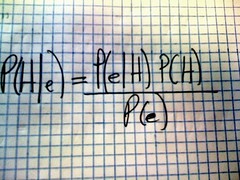
** relations suggested by naive Bayesian - using the Bayesian equation to add missing information, possibly quite naively

The analysis begins with 3 or more of these causality graphs - each chosen from a different discipline of analysis, and each chosen as the "simplest" thing that could possibly work, to start.

The graphs suggest experiments to carry out, and the graphs can be scrutinized.

The graphs change, more are added, some are deleted, just keeping 3 or more, with examples from different effective domains of analysis (one graph may be suggested by the laws of physics, another by the laws of economics, another strictly statistical from historical data, another from political science storytelling, etc.)

Some quite optimistic (borrowing the analysis of the most active participants) and some quite pessimistic (even so pessimistic so that a majority of current activity would not be advised by the model).

Each is must simpler than reality, and, thus, suitable to run against many many different future eventualities. Keep them simple so they are nimble and responsive tools.

None would really be defended as the complete, because so simple. The cost of any complexity is considered to be great. Simple models, easily manipulated, quickly manipulated.

We would have a personal standard of rationality, and a lower standard for semi-rational actions in a group (economic/social groups are demonstratively loath to hold themselves to the highest disciplines of rationality). For the personal standard of rationality - think Socrates. For the lower standard of group semi-rationality - think Rush Limbaugh and Glenn Beck. Neither is better or worse than another, each is to be used in their own domain. The real-world economic/social group would immediately feel paralyzing anxiety when presented arguments from people who hold themselves to the highest disciplines of rationality - so it is irrational to present that to them.

Everything about causal inference in 40 pages: "
Judea Pearl describes his new article Causal inference in statistics: An Overview as 'a recent submission to Statistics Survey which condenses everything I know about causality in only 40 pages.' That seemed like a bold claim, but after reading it I'm sold. I don't come from Pearl's 'camp' per se, but I found this a really impressive overview of his approach to causation. His overtures to folks like me who use the potential outcomes framework were much appreciated, although it is clear throughout that there is still intense debate on some of the issues. The bottom line: if you've ever wondered what the structural equation modeling approach to causal inference is all about, this is your one-stop, must-read introduction (and an insightful, engaging, and thorough one at that).
"
Reblog this post [with Zemanta]

Preschool, pretty cool!

Honestly, was before my anxieties built up. Starting with first grade, I lived inside my head, and that was not a pleasant place to be.
Teaching in the Montessori pre-school

Man, I am so glad my daughter finds new places and new people fun. If a kid learns nothing else except:

1) that other people are far too interested in themselves to notice you

2) what other people think of you is none of your business

3) not much counts besides ** having a long term vision that you can change as evidence suggests, ** having the ability to stick with a long term plan, ** having the patience to work through the difficulties, ** having the guts to not be afraid of being knocked down, ** having the nerve to stick with it until you achieve success. Every other think is of far far far less importance. No grade in no subject will count as much.


Basketball is widely enjoyed by American youth...Image via Wikipedia
But, man, these lessons are hard to learn, and US culture does not make it any easier.
Reblog this post [with Zemanta]

Thursday, December 3, 2009

Patience and Impatience: both are curses and both are blessings

Start with a quote:

Patience is the support of weakness; impatience the ruin of strength.
Charles Colton


Day 84 - Yin Yang Socks!Image by Scootzsx via Flickr
I have been thinking about how in Eastern philosophies, there is a tolerance for explicitly integrating the contradictory, like how lightness and darkness are explicitly integrated in the Yin-Yang symbol.
Two seemingly contradictory character traits are patience and impatience.

Impatience can be a virtue when it propels you to make a positive change, because you cannot tolerate settling for less anymore.  Patience over a bad situation, when your freedom allows you to change, is a curse.  (Don't confuse outer constraints of liberty with inner freedom to choose your own response and choose your own meaning.  We are speaking of Viktor Frankl's "The Last Freedom".)

Patience can be a virtue when you forgive yourself for taking a step back, because, after a re-charge of energy and re-focusing of attention, you can take two steps forward.  Impatience, in that situation, can be a curse because it may make you catastrophize and become helpless because you are hopeless.

¿Habrá suerte?Image by Alberto Casanova via Flickr
A shift between the ideal and realistic, back and forth, can be a mature way to grow in inner capability over years.
Both fostering the ideal as a goal to work towards, and fostering the realistic to maximize effectiveness in that work, are skills that can be improved.
Reblog this post [with Zemanta]