Showing posts with label Climate change. Show all posts

Friday, July 30, 2010

Thoughts on Roger Pielke Jr. | Stand-Up Economist - Yoram Bauman

wikipedia.org - Childe's_Tomb

Thoughts on Roger Pielke Jr. | Stand-Up Economist - Yoram Bauman
As an economist, I found Roger’s lack of discussion of climate impacts to be extremely disturbing. If—totally hypothetically—the science said that hitting 450ppm would cause the planet to explode, I’m pretty sure Roger’s talk would have looked different. (At least I hope so!) The economic point here is that cost-benefit analysis has two halves—costs and benefits—and you can’t do it by just talking about one of the two halves. Why Roger failed to talk about both halves has me totally perplexed and leaves me questioning how much he actually knows about economics. (For the record, he’s not an economist, so I think this is a legitimate question, not an insulting one. He’s a political scientist, but his talk was not about the intersection of science and politics; his talk was fundamentally about economics.)
RPJr's rhetorical trick "there is a lot of misunderstanding and misrepresentation displayed in this post... Fortunately, my new book covers all of these points so that there should be no ambiguity in my views." is annoying.
As if a book is a tomb for the ideas of a public intellectual, and it makes them incapable of stating plainly their views in public forums.

Y. Bauman refuses to play ball:
"Okay, here are some questions: (1) What did you say about the tenets of climate science? (Then I’ll try to get a video of your talk and see if I owe you an apology.) (2) How would you quickly characterize the main points of your talk? (3) Since you note above that you “did not discuss costs or benefits”, I’m curious about why. Do you not think cost-benefit analysis is important? (4) How (if at all) would your talk have been different if the scientific consensus was that 450ppm would destroy the planet?"
Is RPJr so craven as to simply "hit-and-run" from this forum, now that the questions are specific?  Stay tuned!

~~~~~~~~~~~~~~~~~~~~~~~~~~~~~

Related posts:
[Edit 7/31/10]

To my surprise, RPJr replied; his answers:
1. I used a “bathtub” model to describe the challenge of stabilization and I argued that everyone in the debate on all sides agree that CO2 has impacts. Where there are debates is when those impacts become dangerous (the height of the bathtub, e.g., 450 ppm) and the consequences of spilling over. Such debates are of course legitimate.
2. Three points: A. Targets and timetables for reducing emissions now being discussed or even enacted in law (e.g., in the UK) are not credible (I think I proved this), B. Stabilizing concentrations requires advances in technology deployment and innovation rather than GDP contraction (shown a bit, but largely asserted), C. Acccelerating decarbonization requires much greater public investments in technology (asserted not proven).
3. I’ve written a lot of CBA, and teach it as well. This talk was not about CBA, but policy evaluation. I am happy to discuss the topic.
4. I have no idea.
flickr.com/photos/psd/1806225034
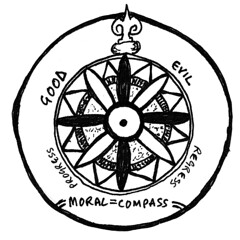
"Moral Compass" by "psd"
My comments to (1): "Such debates are of course legitimate."  RPJr has a problem with the debate coming to provisional conclusion, on the side of the science and the moral question of future generations being left a livable world - a provisional conclusion where we begin work on drastically reducing carbon emissions and mitigate previous carbon emissions, where GDP takes a major haircut if need be.  RPJr's fretting and fussing is consistent with the moral question of future generations being left a livable world always taking a backseat to today's GDP/standard of living - but he doesn't have the guts to admit that, or he realizes that if his cravenness is so obvious, he gives up any chance of political effect.

My comments to (2): Actually, this is the first sensible thing RPJr has ever said, to my knowledge.  It is very true: we have exactly zero experience with asking citizens to voluntarily cut their standard of living for the moral outcome of  future generations being left a livable world.  "Warmists", it can be argued, don't have the guts to admit this, or they realize that if they are so truthful they give up any chance of political effect.

My comments to (3): Why talk to economists about policy evaluation without reference to cause and effect?  That was Y. Bauman's original puzzlement.

My comments to (4): Pathetic.  Again, RPJr cannot deal with science predicting catastrophe (catastrophe, because it is hard to imagine the moral monsters that could cheerfully leave future generations an unlivable world), because his goal is that he moral question of future generations being left a livable world always taking a backseat to today's GDP/standard of living.  That can be used to perfectly predict his reaction to anything.
Enhanced by Zemanta

Wednesday, July 21, 2010

The link between Judith Curry and John Christy

http://www.flickr.com/photos/oobrien/15139012/ oobrien
Judith Curry has the annoying habit of constantly recommending articles that she, herself, has not read closely and cannot personally vouch for.  As if she is feeding the text of opposing arguments to a mailing list, in partial real-time, and parroting back the links.

Plus the reality of SingerLomborg, and John R. Christy being spent forces for irrational climate inaction and denialism, because prior talking points have been proved absolutely ridiculous over just a few years.

So the next wave of voices, with watered down arguments and moved goalposts, are Pielke Jr. and Judith Curry.

Offering articles that you cannot stand behind yourself is just another "heads I win, tails you lose tails I don't lose" trick in the Art of Controversy.  So at least I can inform myself about the original source of the weak-soup arguments.

With not much to go on, and probably too much leaping without looking, I sense a link between the new voice of Judith Curry and the spent force of John R. Christy, made famous for his hatchet job on Al Gore in the Wall Street Journal opinion page.

~~~~~~~~~~~~~~~~~~~~~~~~~~~~~


http://acmg.seas.harvard.edu/ess/index.html

NASA EARTH SCIENCE SUBCOMMITTEE REPORTS

Last updated August 29, 2009
The NASA Earth Science Subcommittee (ESS) advises the NASA Advisory Council (NAC) on priorities within the Earth Science Division (ESD), focusing on tactical implementation of the strategic vision expressed by NASA Initiatives and by external inputs from organizations such as the National Research Council (NRC). ESS was organized by NASA in April 2006 and presently has the following membership: Byron Tapley (chair), Daniel Jacob (vice-chair), John R. Christy, Judy Curry, James Hansen, Raymond Hoff, Gregory Jenkins, William Large, Patricia Matrai, Patrick McCormick, Anna Michalak, Jean-Bernard Minster, Michael S. Ramsey, Steven Running, Kamal Sarabandi, Robert Schutz, Hank Shugart, David Siegel, Mark Simons, Konrad Steffen, Charles Vorosmarty. Executive Secretary for ESS is Lucia Tsaoussi.

http://terryfrank.net/?p=2725

Nobel Laureate Dr. John Christy: “Without energy, life is brutal and short”
DAILY NEWS & COMMENTS
Yesterday’s Wall Street Journal pointed to an interesting notable quote:
And when we build — and I’m one of the few people in the world that actually builds these climate data sets — we don’t see the catastrophic changes that are being promoted all over the place. ??For example, I suppose CNN did not announce two weeks ago when the Antarctic sea ice extent reached its all-time maximum, even though, in the Arctic in the North Pole, it reached its all-time minimum.
http://www.freerepublic.com/focus/f-news/1919858/posts

JOHN R. CHRISTY: My Nobel Moment (2007 Nobel Peace Prize)
Wall Street Journal | November 1, 2007 | JOHN R. CHRISTY
Posted on Thu Nov 01 2007 18:35:15 GMT-0800 (Pacific Standard Time) by neverdem
I've had a lot of fun recently with my tiny (and unofficial) slice of the 2007 Nobel Peace Prize awarded to the Intergovernmental Panel on Climate Change (IPCC). But, though I was one of thousands of IPCC participants, I don't think I will add "0.0001 Nobel Laureate" to my resume...
http://www.exxonsecrets.org/wiki/index.php/Deniers:_John_Christy


Enhanced by Zemanta

Tuesday, July 6, 2010

The Post-Email-Hacking phase of climate denialism - What can we expect?


Below is a great reply to RPJr from Bart Verheggen/ourchangingclimate

[To go along with Michael Tobis' http://initforthegold.blogspot.com/2010/07/roger-jrs-top-ten-opinions.html]

I really appreciate Bart quoting of David Keith:

http://groups.google.com/group/geoengineering/msg/d5955c3b1446194e
"However when people and the political community hear technical people say “can’t be done” they assume we mean that technically can’t be done and that is untrue and destructive.
It’s destructive because it hides the central moral choice: we could cut emissions if we want to, we could have started decades ago when the scientific warnings about climate change were first raised, but we decided not to. It was a choice, implicit or not. A choice that, in effect, we cared more about current consumption than we did about preserving our grandchildren’s chances to enjoy a climate like the one in which our civilization developed."
Where do I agree with RPJr's list, and the viewpoint of the very-very-balanced never-dare-call-us-deniers boys and girls?  The most I would grant to RPJr, Fuller, et al. is that the lack of political will is as least as important as the science.  (I will not grant any more, because their behavior is consistent with a mania to provide intellectual cover for the powerful who refuse to consider a change in consumption consistent with the mainstream scientific view of the risk of climate disruption and ocean acidification.  The behavior consistent with mania (squealing for false balance and blubbering from hurt feelings from those naughty scientists) separates them from rational actors.)

These fellows cannot help but telegraph their moves, and, reading the above from RPJr, we can infer that in the near future morality and moral consequence will completely vanish from scope of their analysis.  It is a three-legged stool - science, morality, policy - and it is sufficient (and efficient) to attack a single leg to compromise the whole.  Their arguments (along with Kloor and Curry), now we are in the post-email-hacking phase, will suddenly be devoid of moral language, and they will open up the waterworks with Glenn-Beck-like whaling sniveling if any mainstream climate scientist dares to use moral language or draw out moral imperatives.

RPJr has already practiced with the term "stealth advocacy" for any climate scientist who has not suffered frontal lobe damage - in other words, for any scientists who is a whole human and cannot resist finding out the consequences of common moral imperatives (that we human individuals owe the future of the same quality (if not quantity) that we owe to the past that born us), and acting accordingly.

Comment on Pielke Jr’s main conclusions « ourchangingclimate/Bart

9. In their political enthusiasm, some leading scientists have behaved badly. (Pielke)
Without specifics, this is impossible to answer, and is bound to lead to even more misunderstanding. I could try reading your mind of course. You probably have some of your critics in mind, notably some RealClimate scientists as well as Hansen, who you have criticized. I find this very problematic. In most instances that I followed (involving Gavin Schmidt, Michael Tobis, Eric Steig, Hansen, Briffa at different occasions), I have found your and others’ criticisms off base, besides the point, largely irrelevant to the bigger picture and having the smell of a smear campaign (science-bashing). As I commented regarding the latest McIntyre affair (see my review here): “A lot of scientists are getting understandably frustrated with self-proclaimed auditors of science (and their supporters) who cast doubt about a whole scientific field by blowing minor flaws out of proportion and insinuate accusations of scientific misconduct”. Against this backdrop of a lot of people ready to embrace any little nitpicked criticism as if it overthrows the whole scientific consensus, and ignore the mountain of evidence in favour of this consensus, I can perfectly well understand that a lot of scientists (and their supporters) are getting frustrated having to deal with this behavior and (mostly) fake arguments. In the grand scheme of things, the big problem as I see it is the contempt of science and its practitioners by a sizeable segment of the general public and some high profile bloggers; if a scientist responds to faux criticism in a frustrated tone, I find that a minor flaw in comparison. Granted, they (climate scientists) are your subject of study, so you naturally focus on their behaviour, but at the same time, please consider the context in which they operate, as well as the main message they are trying to convey. In light of this, your claim that “bad behavior by the folks at Real Climate does more to hurt the cause for action than the political actions of the skeptics” is preposterous. William Connolley brought up Fred Singer as the most obvious example.
Enhanced by Zemanta

Friday, June 25, 2010

Is climate science unique? Do the scientists need to be protected from themselves?

I discussion of bias, or is it a license to dispense with scientific results that are displeasing?  Where are the outside mechanism to help scientists when they cannot help themselves, because of their own bias.

Why is the mechanism of publication insufficient, when in all other scientific fields it has been exactly the way that the scientific community/mainstream dispensed with invalid results and replaced them with valid ones?

Collide-a-scape » Blog Archive » Collide-a-scape >> The Unbearable Lightness of Bias

If these (don’t-you-dare-call-them-deniers) “bias-busters” could point to successes in other scientific fields for other scientific questions, all thanks given to their “bias-busting” scrutiny, a lot of people would see the benefit and drop suspicion.
Otherwise, we must pre-suppose that climate science is a “nonesuch” science — the only scientific domain where the practitioners must be protected from themselves.
Where is the rich history of success of outsiders providing “bias-busting” services for scientists? The outsiders that really help scientific progress get to know the practitioners and labs and journals so intimately, they end up having choices about how they ultimately publish and add to the literature — and that is, in fact, how it ultimately plays out successfully. And *not* by providing outsourced “bias-busting” services.


reply to Hector M. #14
I don’t deny that some assert that climate scientists must be protected from themselves.  I am curious to learn of the historical cases where outsiders’ free-lance bias-busting was found to be successful.
Because similar arguments were made that a cabal of Darwinists suppress papers that show intelligent design, and a cabal of medical regulators suppress papers that disprove tobacco carcinogenicity, and a cabal of dentists suppress facts about fluoridation’s mild control properties.
If I could consider the historical cases of success of outsiders’ free-lance bias-busting, when scientific practitioners needed to be protected from themselves, I could discern between clear-eyed skeptics and delusional denialists, and see if the proposed cure fits the illness.
Much like the judgement of the need for carbon taxation may be informed by the history of regulatory prohibitions of  fluorocarbons.  (Or the regulatory prohibitions on the sale of alcohol in the United States, they don’t all have to be positive examples of regulation.)
I am genuinely interested to learn more about outsiders’ free-lance bias-busting in science, where it had an effect, maybe good, maybe bad.  You overlooked part of my original remark in your reply.


It would be much easier see the good intentions of these denialists, if they didn't demand that everyone assume that climate science is a nonesuch science.

[Ugh, more]

reply to Judith Curry #24

"Scientific biases are challenging enough, but when these are augmented by political bias and a policy agenda, then the bias issue becomes the overwhelming challenge for the science."

This is asserted, but not demonstrated.

As a process that embraces self-correction, it is hard to come up with examples of errors that science has allowed to let stand, for all time, because of political bias and a policy agenda. I can't think of any.

[Aside: The closest I can think of is the denying of the possibility of a numerical intelligence quotient in the polite company of scientist, even though it is at least as well established as the Big Five Personality model, which is uncontroversial. But does that even count? Nobody is barred from publishing and the truth is available to the motivated. I am genuinely curious - Are there any examples of errors that science has allowed to let stand, for all time, because of political bias and a policy agenda?]

Is there really a need for a unique outside agent to police bias in climate science, alone?  The same process of refereed journal publication, that serves the scientific community/mainstream in other fields to dispense with invalid results and replace them with valid ones, breaks down *only* for climate science?  And where is the model for successful outside policing of scientific bias?  Does one even exist?  That would be even more controversial than the already controversial remedy of carbon taxation, because there is already research on the economic effects of taxation, and a history of taxation to counter perverse externalities.

Or is the issue of bias - a bias so insidious science should not dare to leave the extermination to mere scientists - a red herring?

The demand to treat climate science as a "nonesuch" science is the rub.  How can I distinguish a prickly intolerance for the possibility of bias from an excuse to discard results that are unwelcome from an excuse to disregard consequences of status quo behavior?

Reply to Bill Stoltzfus #26

Part of the reason that Judith Cury's "Team B" idea went over like a lead balloon was that the name "Team B" had an unfortunate historical connotation to the "Team B", commissioned by Director of Central Intelligence George H. W. Bush, of "outside experts" who attempted to counter the positions of intelligence officials within the CIA.  In reality, the CIA failed to represent USSR as enough of a military threat for the liking of defense hawks, so Team B manufactured Soviet military capabilities from whole cloth.  http://en.wikipedia.org/wiki/Team_B

I would rather 100% of published scientific results be attempted for replication by third parties, rather than 20% of funding be spent on fishing expeditions.  Because, if this is a mechanism outside of current scientific publishing guidelines, a group of outsiders would choose where the 20% was directed.  Leaving aside the issue that the comparative invulnerability to political and other agendas of this extra-scientific group is being simply asserted without basis.

Then there is the strange issue why science is singled out for hobbling.  What percentage of business, family, or personal decisions (the analog of scientific results) must be legislated for scrutiny by third parties?  Because is the track record of science worse than the tract record of business, family, or personal decision making?

[double ugh, even more]


Reply to Steve Fitzpatrick #29

I am looking for ways to distinguish accusation of insurmountable bias in climate science from such claims made against in evolutionary biology, tobacco carcinogenicity, vaccine research, etc.

You bring up FDA regulations, but then conflate the issue by stating "Note that these regulations exist in good part to eliminate as much as possible the influence of biases", when in fact these are strictly to try to prevent direct harm to patients by the treatment intervention under investigation.  Demonstrated by how they do nothing to prevent biases that don't strictly harm patients directly -- how else could the bias for over-reliance on pharmaceuticals stand?...  if these were, by design, to try to eliminate bias?

"But a more relevant question is “Are there examples of errors that science has allowed to stand for a significant period of time?”  A search for these kinds of examples might not be so difficult."   Then humor me.  The remedy, to fit the topic, must be an extra-scientific mechanism to eliminate bias that scientists are fundamentally otherwise unable to.  To best understand the beast being discussed, I would appreciate examples.  If it never existed, and never will, then that is the very definition of a red herring to discard results that are unwelcome and an excuse to disregard consequences of the status quo.  I would like to see this is a good faith argument.

I don't deny that the public demands more from climate scientists than protein folders.  But I want to see the distinction of the demand from the demands put on evolutionary biologists by members of the public, from the demands put on mathematicians by those who trisect the angle or square the circle, from the demands put on medical animal researchers by the property destruction and harassment by anti-vivisectionist protesters, etc.  Are the demands, for the most part, strictly to promote scientific truth found in the least time in the efficient way?  Or not?
Enhanced by Zemanta

Thursday, May 27, 2010

Speaking of Uncertainty with a Mumble-Bumble-Mouth - Mike Hulme

This tornado damage to an Illinois home would ...Image via Wikipedia
Mike Hulme: We must stop saying ‘The science demands…’ by Tim Black - Spiked Debate

Mike Hulme prattles on about uncertainty.  [Ignore the bio photo of MH staring triumphantly at his rightmost piece of horizon]

Oh bleh, this Mike Hulme is not even operating at the level of the blogger Phillip Price, who is simply blogging on this topic as a layperson. Hey Hulme, we have tools for discussing uncertainty, and we can demonstrate the deniers are actually asserting much more certainty about the future, evident by their unwillingness to "take out an insurance policy" by starting to tax carbon even at a small amount. And they are asserting a much lower sensitivity than any physical theory can justify:

Phillip Price actually takes time to draw the curve of his uncertainty, a rigor the denialists avoid, no matter how Phillip Price attempts to draw it out of them:


I agree that science, morality, and policy are best kept separate. But just using the word "uncertainty" for anything besides Revelatory Holy Scripture is silly, acting as if we cannot meaningfully compare different qualities and quantities of uncertainty.

If I take out an insurance policy on my house today, and my neighbor does not, it can be argued that I am rationally dealing with uncertainty, while my neighbor is simply non-rationally wishing it away, ineffectively.  I do not necessarily buy insurance today because I am _certain_ that I will have suffer arson or tornado.

If Hulme's writings lead to less harmful confusion of science, morality, and policy, I will provisionally temporally forgive him sloppiness with the term "uncertainty".
Reblog this post [with Zemanta]

Thursday, May 13, 2010

Seth Roberts, wrong about doubting Climate Disruption Risk

Artist's rendition of Earth's magnetosphere.Image via Wikipedia
Wanted to highlight Phillip Price's responses to Seth Roberts, on the existence of human caused risk of climate disruption.

Seth Roberts, wrong about doubting Climate Disruption Risk:

"
Phil Says:  May 11th, 2010 at 12:26 pm

Seth, as you might imagine I disagree with almost everything you say here. But let me give just one example. You say:

“Here’s what I would consider reasonable evidence for serious human-generated global warming:

1. Temperature higher now than in the past.
2. Temperature increasing at a higher rate now than in the past.
3. Good (= verified) model shows serious human-generated warming.”

But in fact, neither of the first two would be reasonable evidence of serious human-generated global warming if they are true, and the absence of them does not indicate absence of serious human-generated global warming if they are in fact absent.

Here’s the key fact that you seem to be unaware of (but that scientists who study this know very well): MORE THAN ONE PARAMETER AFFECTS THE TEMPERATURE OF THE EARTH. It’s not all about carbon dioxide concentrations.

If high temperatures in the Medieval Warm Period were due in part to higher solar activity, then those temperatures don’t tell us much about climate sensitivity to CO2. So your point 1 doesn’t really make sense. The issue with point 2 is pretty much the same, except with regard to the derivative of temperature rather than temperature.

And for the models…you assert that the models aren’t good enough to estimate temperature sensitivity, but you’re wrong.

Yes, I know that scientists, like everybody else, tend to be overcertain. But I don’t think that means that nobody knows nuthin’.

I asked you before, more than once, to give YOUR estimate of climate sensitivity (defined as the steady-state change in global average over preindustrial levels in response to a doubling of CO2 over preindustrial levels). You still haven’t answered that question. But it seems that for some reason you put very little of your probability in the range that almost all climate researchers think is most likely. So who is being overcertain?
"

Phil Says: May 12th, 2010 at 2:55 pm

Check the IPCC report, chapter 8: http://www.ipcc.ch/pdf/assessment-report/ar4/wg1/ar4-wg1-chapter8.pdf there is an extensive discussion of climate modeling and why it is good enough to be sure that anthropogenic climate change is real and why the key parameters are likely to be not extremely far from the (admittedly wide) range of estimates.

But what I am taking issue is with much larger than your three assertions, though I think they are all incorrect.

You are criticizing people for being “overcertain” because their estimate of climate sensitivity has an uncertainty of “only” 6C, but your own estimate has less uncertainty than that, in addition to being centered much lower than the experts think is reasonable. I do not think you have any basis for having a narrower confidence interval than the experts do, and I do not think you have any basis for having a much lower central estimate than the experts do.

[ Edit 05/13/10; Michael Tobis weighs in ]

Michael Tobis Says:  May 13th, 2010 at 12:10 pm

To your first two points, there is nothing that says that warming has to be simultaneous with greenhouse forcing. Under present circumstances we in fact expect the contrary: the thermal inertia of the oceans and the masking of industrial dust mask the committed warming. So your proposed tests simply aren’t valid.

Also, climate models make effective predictions of many things, not limited to global mean surface temperature. As a particular point, they show and have shown since the 1980s that greenhouse forced warming is a near-surface phenomenon, accompanied by stratospheric (upper atmosphere) cooling. They also show a pattern of warming that concentrates on land areas in continental interiors. These long standing predictions did in fact emerge. So your claim that climate models are without skill are without foundation.

All of this is silly; it treats “global warming” as a falsifiable theory, a claim of a causation that is either true or false. This is foolishness. The underlying phenomena, (thermal radiation, absorbtion and reradiation in gases) is two hundred year old physics that is as well established as anything in science.

What’s at issue is not “whether” but “how much”. As Phil correctly points out, those who call themselves “skeptics” are not making an argument from ignorance, they are making an argument from certainty. If we really had no idea what the sensitivity was, we should be more concerned than ever. The attitude suggested by people who claim to be “skeptics” is utterly inconsistent with a lack of confidence in the underlying science. It is a claim that the the sensitivity is certain to be much less than all prevailing evidence indicates.

(Phil’s a bit pessimistic; I’d say the consensus range is 2 C to 4.5 C per CO2 doubling. http://www.nature.com/ngeo/journal/v1/n11/abs/ngeo337.html )

And what if it were zero? Would we be out of the woods? No, even with a global sensitivity of zero we could have huge forced climate change, say, warming the poles and cooling the tropics. There is no doubt that the amounts of CO2 and other gases we are adding to the atmosphere change the way energy flows through the system, a system which at heart is fluid and easy to change. Even in the absence of knowledge and a low global sensitivity there are huge risks.

And then there is ocean acidification.

http://en.wikipedia.org/wiki/Ocean_acidification

Sorry. We have to deal with this.

[ Edit 05/13/10; my comment added ]

Seth Roberts says:
seth Says: May 12th, 2010 at 2:47 pm
[...] I’ll provide you my confidence interval in a few days.
It will not be forthcoming.  This was all a predictable exercise in the Art of Controversy.  But it is good to document how these each can be swatted down with minimal effort.
Reblog this post [with Zemanta]

Friday, May 7, 2010

The difference between Skeptics and Deniers

Monument of the People Revolution, Laksi Circl...Image by adaptorplug via Flickr
[ This post started life as a comment on the wonderful blog "Watching the Deniers" by Mike in Melbourne.  I am so happy Mike started his blog, because the Climate Disruption Deniers have a very shallow bag of trick, and they have them well worn from past fake controversies like tobacco carcinogens.  So it is great to have a blog dedicated to this.  ]

What is the difference between being skeptical and being a denier?

Skepticism can be a positive attribute.  Being called a denier is always a slur.  Is there a difference?  This is how I make the distinction.

(1) If skeptical, you realize the goal is to eventually replace the mainstream narrative with a new, fundamentally different narrative, at a higher standard of argumentation from statements of certainty.  If you are a denier, you are content to perpetually muddy the water to generate fraudulent controversy.  The test between the two is that the skeptic will dish out their harshest approbation to people on their own side who have no capacity for being constructive and who have no capacity to make valid judgments about quality of argumentation; where the denier in comparison will hold embrace any momentarily useful troll.

(2) The mainstream must accept the discipline of the highest standard of argumentation and demonstration - that is only right to be seen as mainstream.  If you are a denier, you take this to mean that the enemies of the mainstream are allowed to have no standard.  If skeptical, you allow the opponents of the mainstream to have a lower standard, but a standard none-the-less (a lowered standard is to remain productive until a cohesive alternative narrative has been fully developed).  The test is that the skeptic will throw people on their own side out of their camp if they cannot maintain consistently a minimal standard of quality of argumentation and demonstration.  The denier will continually forgive transgressions for any momentarily useful troll.

(3) If skeptical, you take delight in sound results, no matter from your own side or the opposing side.  If a denier, you have boos and hisses for all results, no matter how sound, from the opposing side - and cheers and huzzahs for all results, no matter how shabby, from your own side.  The true skeptic has more latitude with their boos, hisses, cheers, huzzahs.

(4) if skeptical, you see the value of provisional agreement on results today, perhaps to informed by new facts tomorrow, perhaps not.  If a denier, you shriek at any provisional agreement, no matter how relatively settled it is compared to matters of no discernible meaningful controversy, like planetary orbital physics.  If a denier, you shriek at any attempt to blow the foulest vapors of shabby results out of the room.  The denier does not need his viewpoint to prevail - the denier is satisfied with a permanent state of cacophony of controversy.  The skeptic is motivated by having their viewpoint prevail by quality of argumentation and demonstration.

(5) if skeptical, you see that uncertainty can be a valid reason to act today - for example, I buy home-owners insurance today because of uncertainty.  Nobody waits to buy insurance until they get a letter of intent from an arsonist that their home is scheduled to be set on fire.  If you are a denier, you give a privileged status to the status quo - if a denier you effectively say we must not deviate from the existing state until all uncertainty has been eradicated, which is a socially acceptable way to say we must not deviate from the existing state ever.

(6) if skeptical, you value sound results over decorum - all things being equal, decorum is preferred; but no amount of decorum can substitute for sound results.  If a denier, there is no amount of production of sound results that can forgive an opponent of a perceived violation of decorum.

These 6 are unnatural for people, because humans will regress to tribal behavior under stress.  The are only evident in people who value truth over the status of their own tribe.

In my own case, I am most interested in the economic and political consequences for AGW (Anthropogenic (man-made) global warming) or climate disruption, and I am not in complete agreement with the mainstream of the AGW believers when it comes to the economics and politics.  But the standard is so weak on the alleged skeptical side, I can only meaningfully develop and test my personal ideas with the AGW believers side.  That has been my experience.  Even Joe Romm, who is supposedly the worst of the worst of the AGW mainstream believer bullies, has demonstrated nuance when it comes to considering different economic tools.

I would like to see a demonstration that the AGW/climate-disruption mainstream side is worst at being skeptical of their opponents, than the skeptical/denier side.  The standard is so low on the AGW alleged-skeptics/deniers side, they would never agree to the above 6 points.

Reblog this post [with Zemanta]

Monday, April 12, 2010

Michael Specter’s new book ‘Denialism’ misses its targets

Book review on Grist.org, by Tom Philpott

http://www.grist.org/article/2009-10-31-michael-specter-denialism-organic-GMO

Scientific Denialism is an important topic, but we have to be wary of those who would simply pick winners and losers among those who sponsor denialism; in Michael Specter's book, for example, carbon fuel burners goodorganic food producers bad.  But both make scientific denialism part of their public relations schemes.
But there's another, even more glaring oversight at work here. In a book devoted to "denialism," and "how irrational thinking hinders scientific progress, harms the planet, and threatens our lives," there is almost no discussion of the most powerful and successful of all the denier cliques: those who insist human-induced climate change is a hoax.
...
But political and economic power are precisely what elude Specter's gaze. This great defender of science appears to be cursed with something that a love of science should have cured: naiveté. To be sure, the kind of know-nothing, reflexive anti-scienticism that Specter deplores certainly exists; and its adherents need a kick in the pants. Specter's boot misses the target. Moreover, he sees deniers everywhere, except where they are actually powerful and effective: denying climate change.
Unfortunately, to bring seriousness to the issue of climate disruption, it will take just as much work among the "friends" of science as among the "enemies" of science.

Friday, March 26, 2010

Rest In Peace, Hockey Stick

Unicycle hockeyImage via Wikipedia
We will start with the quote from Ian Jolliffe, and work backwards to unpack.

"http://neverendingaudit.tumblr.com/post/472646295/i-am-by-no-means-a-climate-change-denier-my"
“I am by no means a climate change denier. My strong [impression] is that the evidence rests on much much more than the hockey stick. It therefore seems crazy that the MBH hockey stick has been given such prominence and that a group of influential climate scientists have doggedly defended a piece of dubious statistics.”

-
Ian Jolliffe"
My comment:
I am surprised to hear, today, that considered authoritative option thinks that the "hockey stick" is bad statistics, and that people who believe in global warming should admit this error, strive to be more rigorous, and move on with the other overwhelming facts of global warming.

I will modify my view.
Lets now work backward.


Jolliffe requests an apology from Tamino, because he feels words were placed into his mouth, to give full liberty to any use of the statistical technique of "decentred PCA" when a different origin is considered to be meaningful, even though he did no such thing. "Decentred PCA" is the technique that Mann used to bring the hockey stick into clearly resolved existence.

A reasonable starting place, from a moderately skeptical point of view, for information on Michael E. Mann's "Hockey stick": "http://en.wikipedia.org/wiki/Hockey_stick_controversy"

Tamino apologized (also at "http://tamino.wordpress.com/2008/08/10/open-thread-5-2/#comment-21873"), re-iterated that "It also seems to me (and I'm by no means the only one) that the origin in the analysis of MBH98 is meaningful" and ended by emphasizing a part Jolliffe's reply - "... the evidence rests on much much more than the hockey stick. It therefore seems crazy that the MBH hockey stick has been given such prominence ..." - which can be interpreted as back-tracking.

This has allowed some merchants of obscurantism to make hay: "http://climateaudit.org/2008/09/08/ian-jolliffe-comments-at-tamino/".

[Edit 04/16/10]

The above applies only to the original Mann hockey stick, for an overview of the evidence from all available sources of evidence of possible climate disruption see:

Reblog this post [with Zemanta]

Friday, March 19, 2010

It is time for some humility - Oh Lordy...

HumilityImage by Perfesser via Flickr

"it is time for some humility, concludes [a deservedly humble man]"

http://julesandjames.blogspot.com/2010/03/statistically-improbable-phrases.html

The sheer nerve of a request for "humility" against those who put their reputations on the line by publishing, under the burden of responsible science.  A request for humility by a humbug.

My comment:

That piece is clearly not a book review (too short and too shallow), and it is not a piece of higher criticism because advances no thesis (concern trolling is the opposite of advancing a thesis).

It is a piece of opinion placed in a corner of Nature where the editors don't have to take any responsibility for the opinion.  And quite a shabby bit of opinion making.

And why this fringe voice chosen?  (Bjorn was caught out misrepresenting sources, the Superfreakonomics chapter was a hash, so RPJr steps up to the plate...  And RPJr's tack will run out quickly as well - it seems to be entirely based on the idea that facts can be "contaminated" by scientists who have a preferred policy outcome.  Because politics is a human activity, and scientists must not be human.)

An disreputable opinion published predominately without risk to reputation. Shameful.  If the self-described "reasonable voices" see the issue not as a matter of scientific fact but as a political or economic one, then commission a paper from a publishing political scientist or an economist.  Instead of publishing potshots and bobbing and weaving and concern trolling.

Was this garbage technique used before against other science that pained industries?  Is there a history of this technique used for tobacco or pharmacological marketing?  Or is energy policy widely understood by "the people who matter" to be all encompassing?

Obviously, industry funds a lot of research.  Is this garbage based on many industry voices among the circle of acquaintance of Nature's editors saying that the economic replacements for carbon fuels are just not ready yet, so the scientific question of human culpability in global warming has to simmer on the back burner for a while?  (Sadly, the industry concerns are probably more cynical than this - an indirect demand from those who get paid today that they deserve to get paid tomorrow, oil rigs or not, refineries or not.)

John Mashey did a bang up job tracking the pitifully few scientists who promote obscurantism against climate science, but I don't recall the editorial boards of top journals being included in his analysis.  And he didn't write about the techniques used in those journals to promote the Art of Controversy against uncomfortable scientific findings.

Reblog this post [with Zemanta]

Wednesday, March 17, 2010

Complicity and Sympathy for Comforting but False & Dangerous Ideas

St JudeImage by Fergal OP via Flickr
Comment on:

http://neverendingaudit.tumblr.com/post/455387977/i-think-we-can-get-past-the-lie-and-it-was-a-lie

When dealing with someone so bugfuck crazy like RPJr or Bjorn, you practically have no choice but to abstract away these bad actors into fake-controversy-creating-automatons, and focus on those who allow these trolls to be heard.  And, practically everywhere from practically everyone, you find complicity and sympathy for these comforting but false & dangerous ideas.

There is no evidence that humanity likes science or the burden of responsibilities that pay out decades in the future.  Humanity does not mind playing with some the end products of both, like consumer electronics or the body of modern medical knowledge, but humanity really doesn't like either science or the responsibility of the very long view.

Our only tools are to consciously move the Overton Window as quickly as possible to something compatible with humanity continuing to exist, and, in the mean time, remember "[Our] basic function [is] to develop alternatives to existing policies, to keep them alive and available until the politically impossible becomes the politically inevitable." (a quote from Milton Friedman, speaking about something other than climate change, but the idea applies).  Obviously, that means our last, best hopes will be way past their shelf life, and we will only be left crude largely ineffectual measures for cooling the globe and dumping antacid into the ocean.  It also means making the best arguments for the alleged "Conservatives" and "Libertarians" for them, because their mental failure modes mean they themselves cannot; because those bodies of thought, reasonably applied, have something to offer to guide towards sensible policy.

[Edit 3/18/10]

Consider RPJr's strange book review in Nature - he is reviewing 4 books, none less than 300 pages, and his review could fit comfortably on 2 sheets of college ruled paper, even though the books are competing for space with RPJr's opinions.

http://www.nature.com/nature/journal/v464/n7287/full/464352a.html

It is a perfect example of concern trolling.  Quoting:

> Incremental approaches to climate mitigation that can be modified by experience offer a chance that realistic and democratically grounded actions might rise to a challenge that will be with us for decades to come.

In other words, don't yell "Fire" in a crowded theater, especially if the theater is actually on fire.  Eventually, enough of the patrons will catch on fire to allow a rough consensus to take hold. Poppycock.

The piece is self-refuting, but the issue is that it was allowed to be published.  We should hold the editors of Nature up to ridicule.  If those editors wish that the issue is taken away from the facts of science and into the realm of political science and economics (as they must plainly feel), then print articles papers from publishing political scientists and economists.  Instead of concern trolls without any stake in substantive argumentation.

[Edit 03-26-10: see comment by Marion Delgado]
Reblog this post [with Zemanta]

Friday, February 12, 2010

Andrew Gelman and Climate Change Concern Trolling

New Troll and Old Troll (Front)Image by Dunechaser via Flickr
Andrew Gelman's blog [ http://www.stat.columbia.edu/~cook/movabletype/mlm/ ] has some of the best writing on climate change when Phillip Price submits a post [ see http://manuelmoeg.blogspot.com/2009/12/talking-about-climate-change-publishing.html ] and has some of the worst writing when Andrew Gelman himself posts.

Andrew Gelman seems to be sympathetic to conspiratorial thinking about the scientific culture around climate change.  My feeling is that in his own field of statistics, Bayesian techniques have been actively suppressed and misrepresented, so Gelman is open to the idea that investigators who don't see human global warming could be actively suppressed and misrepresented too.

Which is fine, if the arguments were not so lame.

http://www.stat.columbia.edu/~cook/movabletype/archives/2010/02/stabilizing_fee.html
(Anonymous concern troll says any paper contradicting Arrhenius' 1896 climate model is likely to be self suppressed. And if this is not the point of the anonymous question, what is?)
http://www.stat.columbia.edu/~cook/movabletype/archives/2009/12/how_do_i_form_m.html
(Before Andrew Gelman steps onto a subway train, he ponders that the civil engineers that designed the train might be laboring under thoughts so stupid that they can only come from some aspect of the civil engineering consensus in a particularly ugly undigested form. And he is paralyzed by fits of panic. And if this is not the point of Gelman's "Beyond my limited sphere of scientific compresension, I dunno", what is?)

It could be more convincingly argued that:

(1) human activity is making an ice age less likely

(2) global warming skepticism and preference for inaction plays a semi-rational role in the debate, not because of the poor quality of their arguments, but as a brake against premature solutions:

365 Days - Day 71 - Hippy Tree HuggersImage by Auntie P via Flickr
Al Gore holding up a mercury light bulb in "An Inconvenient Truth",
Ed Begley, Jr. installing semiconductor solar panels to all exposed surfaces of his home,
the US government giving loans to Tesla electric cars

... all of which are very likely contributing to burning *more* fossil fuels, not less, because the total costs over those product's entire lifetime (including manufacturing plants that themselves burn fossil fuels, including safe disposal of wastes) are unrepresented by the relatively small price charged to consumers.  Better to tax fossil fuels in rich countries and spend that money on research placed in the public domain so even the poorest countries can benefit.  At a gradual rate of increase, so as to have minimum harm to productivity.

But, instead, we get lame concern trolling about scientific conspiracies.  I get the tiresome feeling that the global warming skeptics need to be saved from themselves, to have the people convinced by the scientific consensus to make their best arguments for them, because they cannon help but simply echo the last thing they heard from someone with a direct financial link to oil companies.  Tiresome.

My reply to the anonymous concern troll:

> If the prediction of a climate model is very much outside the consensus predictions, it is not likely to be published.

More arguing that climate science is a nonesuch science.  Taken to the logical extreme, we can argue that Einstein's papers on Special and General Relativity are not likely to be published (and that is why we still use epicycles today).  Taken to the logical extreme, we can posit that Alex Rodriguez is not likely to swing for the fences.  The blockbuster behavior of the players in the 99.999% percentile is poorly predicted by the tentative behavior of the average player.

Secondly, science publishing is not the only market for climate modeling.  Commodities traders and the reinsurance market for hedging risk on multi-year massive construction projects have a need for accurate climate modeling, because on those time scales a long range weather report would be worthless.  Those players are willing to leave millions on the table just so their hired gun scientists can parrot safe results that are unlikely to rattle tea cups at the next faculty function?  Unlikely.

I beg your forgiveness for the following snarkiness.  Can your anonymous concern troll name a single branch of science that has remained on a strictly linear trajectory since 1896?  Besides phrenology.

[ Edit 2/15/10 ]

The goalposts have been moved in the comments is Andrew Gelman's post on February 12.  It moved to always having the models subjected to a growing set of data, never casting out past data (good, good).  It moved to meta-analysis of all available models, over time (good, good).  It moved to the variance of published models compared to the subjective guessed distributions of the individual practicing scientists (fine, fine).  But where happened to the original claim "If the prediction of a climate model is very much outside the consensus predictions, it is not likely to be published."?

My comment submitted:
Marc Levy

> They find that if you ask climate experts to characterize their subjective best guess as to the distribution of key climate change parameters, you observe far more variance ... than you observe when you look at the distribution of all the climate model outputs.


This is to be expected, because no one would represent *any* model as perfectly describing reality - if it was perfect, it would no longer be a model, anymore.  Only pure mathematics has the benefit of being able to switch the analysis to a proved isomorphism that is easier to compute.  Every model is an adequate simplification, over a domain, and it is hoped the failure modes are understood so the model is not misused.  But the option of "proving" the model a perfect representation of reality is not available.

Useful scientific models typically give sharp results - sharper results than field readings, even counting for input precision or rounding in iteration, etc.  The models are useful *because* they give sharp results - or else you would have the perverse consequence of improving the usefulness of a model by adding slop into it to increase the variance.  A bound on the error is useful to track, but no one would actually mix in slop in a model to force the variance wider, even if the model's variance doesn't match field readings.

Any expert would know very well all the possible failure modes and other limitations of a particular model, that so their subjective guessed distribution would have greater variance than the considered model because of that knowledge.  The scientist possess what humans value as knowledge, the documented model cannot (and so scientists cannot be replaced with the models of their creation).  Why else might the variance be greater?  -- perhaps the scientist is in possession of they consider to be a better model, not yet published.  Or perhaps, the scientist is simply aware of the possibility of a better model.

The relatively uncontroversial model of satellite orbits is informative.  They are tighter because they, of course, consider fewer particles than Mother Nature is able to consider.  So they can consider events in the future, because they run faster than reality, and so they can run on economically available hardware.  No one would consider their tighter variance than the variance of observatory readings to be surprising, much less consider it a failure of the model.  Only if there was misrepresentation of best knowledge of the model's error bound, or failure modes, or applicable domain, and then, it would not be a failure of the model, it would be a misapplication by a human agent.

Can I note that the goalposts have been moved?  The original issue was "stabilizing feedback" and the original question contained the assertion "If the prediction of a climate model is very much outside the consensus predictions, it is not likely to be published."  There are other interesting issues to consider, but only after the parties admit that the goalposts have been moved and the focus of the argument shifted.
Reblog this post [with Zemanta]

Thursday, January 21, 2010

Not Evil, Just Wrong (Mostly) - Moral analysis of Global Warming Denial

Michael Tobis does it again, a substantial moral analysis of global warming denial:


SUN VALLEY, CA - DECEMBER 11:  The Department ...Image by Getty Images via Daylife
Not Evil, Just Wrong (Mostly) - Michael Tobis - Only In It For The Gold: "I have no trace of a doubt that sustainability issues are ethical issues. Talking about ethical issues without mention of evil is a bit like playing hockey without looking at the puck.

[...]

Let me be clear. As the movie title (incorrectly I think) claims about President-elect Gore, it is possible to be 'not evil, just wrong' about issues of substance. I believe most of the people who are participating in the attacks on climate science are doing so more or less in good faith, having been led down a path of bizarrely twisted interpretations of who we climate scientists are, what we do, and how we got to where we are. The question is who has been doing the leading.

The confusion about climate science pretty much requires a complete ignorance of the tradition of Jule Charney, [...] and the profound and elegant depth of its achievements. People to whom the Charney tradition is invisible perceive a vastly less sophisticated science than actually exists. It's odd; you'd think the visible improvement in weather forecasting would carry some weight [...]

The Charney tradition (along with the related Stommel tradition in oceanography) is the intellectual core of climatology, but it's pretty much invisible to the outside world. It just doesn't reduce to a nutshell easily. (And at least when I learned the stuff, the pedagogy was lousy to make matters even worse.) So it's easy for people to have essentially no idea that a real and rich science exists. They will put climatology on a par with, say, ecosystem dynamics or economics in 'maturity'.

[...]

But this underestimation is not enough to account for our present dysfunction on this matter. The underestimation of the sophistication of planetary physics does not suffice to argue for 'no need to control CO2 emissions'.


Helsingin Energia 1Image by Geonostalgy for the future via Flickr
Consider what the evidence actually shows based on simple physics that predates Charney and Stommel. As is well-known, that evidence (based in radiative transfer and broadly confirmed in plaeoclimate observations) shows that greenhouse gases play a significant role in the energy flows through the system, so that once human perturbations on CO2 concentrations become comparable to and ultimately exceed natural CO2 concentrations, the balance would necessarily change. We also know from geological evidence that very large shifts in climate are possible in consequence of relatively small forcings. Consequently, large CO2 increases are risky. The less we stipulate that we know about the system, the less we can constrain those risks. The plausible worst case (say the 5% credibility scenario) gets more expensive the less we know. Thus the less we know, the more vigorously we ought to refrain from emissions.

[...]
[... We] are in trouble as a consequence of the success of this program of misdirection and fearmongering. The techniques being used to undermine the communication channels between legitimate science and competent governance will be with us forever. We will forever be challenged by the malicious techniques that have been developed in this trumped-up debate. We had better develop an immune system to this sort of bullshit or sooner or later some sort of spectacular disaster will result.


"

Michael puts a fine point on it in the comments below:

[...]

At issue here is a bunch of more or less innocent scientists, maybe splitting a hair wrong once in a while this way or that. It's about a scientific subculture supported in substance by every major scientific body on earth, and subjected to what amounts to the extreme libel and defamation.  [...]
[...]
If you compare this to a few dozen grumpy bearded green guys who'd love to be just as mean and nasty if they could, you are just resorting to the journalist's favorite hiding place, the middle.
Smokestack of Greater Detroit Resource Recover...Image via Wikipedia

I don't even know if the bearded guys exist, frankly. But even if they do, what importance do they have in the face of this grotesque and successful organized lying, by major media outlets, senators, governors, CEOs and even preachers?

I know balance is your stock in trade as a J-school type, but some situations just don't balance. It's not a law of nature that bad guys are equally distributed on both sides. You actually have an ethical responsibility to pick this time, and to do it right.

Please. Get real. This matters.
The only thing in the favor of those who care about the truth is that the situation is not simply going to go away.

Reblog this post [with Zemanta]

Wednesday, December 16, 2009

Talking about Climate Change: Publishing your Probability Density and Reasoning


The long shadowImage by melancholic optimist via Flickr
"Phil" from "Statistical Modeling, Causal Inference, and Social Science" blog, I believe Phillip Price [ http://eetd.lbl.gov/ie/apt/staff/PricePN.html http://www.creekcats.com/pnprice/Job.html ].

As I say in my comments "Thank you for publishing your probability density for climate sensitivity, and the precise reasoning behind it. This is, practically, the _only_ way to communicate one's considered beliefs for this subject - if one is truly interested in communicating and not just indulging in motivated obscurantism or the art of controversy."

How helpful to have someone state their probability density and reasons behind it. It communicates so much.


"Four out of the last 15 posts on this blog have been related to climate change, which is probably a higher ratio than Andrew would like. But lots of people keep responding to them, so the principle 'give the people what they want' suggests that another one won't hurt too much. So, here it is. If you haven't read the other posts, take a look at Andrew's thoughts about forming scientific attitudes, and my thoughts on Climategate and my suggestions for characterizing beliefs. And definitely read the comments on those, too, many of which are excellent.

I want to get a graphic 'above the fold', so here's the plot I'll be talking about.
WarmingProbDists.png...

Finally, we get to the graphic. Each of these probability distributions is supposed to summarize the belief of a different person. In blue, we have an 'anthropogenic climate change denier.' This is someone who just doesn't believe that doubling of atmospheric CO2 could have any substantial impact on the global mean temperature. I don't know if any such people think the effect could be negative, but maybe they do; if they don't, then just move all of that negative probability into the low positive range somewhere. At any rate, these people are convinced that there is just the right amount of negative feedback to cancel out the known effect of CO2 and the expected effect of water vapor.
...
But I think the hypothetical 'skeptic' curve puts way too much probability on very low values --- not as bad as the 'denier', but still, this is someone who is unjustifiably convinced that negative feedbacks will come close to counteracting the effects of CO2.

(By the way, none of the lines are supposed to go below zero, or even go to zero, at 6C, but the drawing software I used has done some funny stuff there and it doesn't seem worth fixing. Oh, and each of the curves is intended to have the same integral -- unity -- but since this is just a by-hand sketch, they probably don't).

Above, I've opened my soul, as it were, to discuss why I believe what I believe. Part of my belief, actually a substantial part, is informed by a very simple physical model that I believe is useful in spite of its simplicity, that shifts my prior well away from 0 as a reasonable estimate of climate sensitivity. What if you don't have the physics background to evaluate such a model for yourself? Then, you're more or less forced to choose who you care to believe: deniers, skeptics, 'experts,' journalists, bloggers, friends...

In a comment on Andrew's entry about forming attitudes on scientific issues I said this:
When it comes to anthropogenic climate change, if someone wants to allocate some probability to the chance that the skeptics have it right, I think that's a very reasonable thing to do. Make it 90% mainstream, 10% skeptics, or even 75% mainstream, 25% skeptics if you are are heavily inclined towards the skeptical camp. But there are people out there who are 90-10 the other way! If you are an expert climate modeler and you think your colleagues have the science wrong, that's one thing. If you're just some schmoe who only knows what he reads in the papers, and you choose to assign a 90% or 95% probability to the conclusions of the small band of skeptics...where does that come from? Do you really think the experts in a field get it wrong 90% or 95% of the time?
I think I'll leave it there.

"

My comments:

Thank you for publishing your probability density for climate sensitivity, and the precise reasoning behind it. This is, practically, the _only_ way to communicate one's considered beliefs for this subject - if one is truly interested in communicating and not just indulging in motivated obscurantism or the art of controversy.

I wish I had the chops to draw one myself. I don't, so I rely on the experts currently publishing articles. I find it hysterical to shriek about the corrupting influence of funding - I am not holding my breath waiting for the appearance of researchers comprised solely of incorruptible energy, freed of the need for money because they draw sustenance from the empty ether. Oh, please. All humans have their self-serving motivations, and reasonable people deal it with accordingly and with due measure. And, scientists never claimed to not be human.

This diagram shows how the greenhouse effect w...Image via Wikipedia
I wish I had the chops to draw the _other_ curve with regards to carbon dioxide - loss of tonnage of fished protein/nutrition due to ocean acidification. Global temperature and ocean acidification both have a large expected impact on human civilization.

> The Kyoto Treaty was a large scale effort...

Surely the intervention can only earn the description of "large" if *some* authority judges it probable to effect the desired change. Otherwise, I could call the Dubai Towers a "large scale effort" to bridge the span to the surface of the moon.

It can be honestly asserted that no large scale efforts have been made to reduce greenhouse gas emissions.
Enhanced by Zemanta

Tuesday, December 15, 2009

My Nisbet Gripe, Cont'd


full photo of Gobustan rock drawingImage via Wikipedia
Michael Tobis - Only In It For The Gold

My Nisbet Gripe, Cont'd: "I have no objection to the idea of framing messages effectively. Until this week, I had no idea why some people were complaining so bitterly about Nisbet.

But Nisbet is in the strange headspace of politics, where science is just a piece of furniture on the landscape of politics. What's more, it's a black box which emits certain very simple results. And when he describes the box, he gets it hopelessly wrong, and uses the bizarre and broken frames of the worst elements of the press.

The problem isn't the concept of framing. The problem is that the guy who has done the best job of staking out 'framing' as his personal territory has about the most toxic set of frames out there for our issues. There is no getting rid of writing to your audience, but the word 'framing' itself isn't all that valuable. If it belongs to Nisbet I don't want it.

One thing I've learned recently is that while in many ways I behave like a journalist, I simply have almost no interest in 'news' any more than I am interested in 'sports'. Events in sports fall clearly into the space of 'don't matter'. In fifty years nobody will remember who won the superbowl this season. In politics, they will remember Obama's name, but little of what he said or did.

As long as we play on the battlefield of week-to-week politics and don't actually look into the science box, we lose the war of words. Yes, the right is disposed against us and the left toward us, pretty much for arbitrary cultural reasons. But the opposition is free to twist the facts and we aren't. So they pick off people as they start to pay attention and the mythology of massive corruption in climate science gets further elaborated.

If we don't play the long game, if we don't try to revive critical thinking and evidence-based reasoning, if we don't go beyond assertion and into explanation, we are playing on the opposition's turf.

Nisbet may have done a good job of describing the opposition's turf, but that is all he knows. He, specifically, is an example of a person lacking a scientific education remotely commensurate with his capacities and interests. His approach embodies the substitution of politics for knowledge.

The long game is our home turf, and we have to stop listening to people who miss that point completely. The absurdly short time scales and shallow symbolic allegiances and frantic half-crazed yuppie obsessions du jour of the beltway and the press are the problem, not the solution.

"

My comment to the post:

I am slack-jawed. You summed up Nisbet perfectly. You communicated better than I could have, exactly how Nisbet rubs me the wrong way. I am compelled to go into detail about how good a job you did.

> Yes, the right is disposed against us and the left toward us, pretty much for arbitrary cultural reasons.


Climate Control entranceImage by vodstrup via Flickr
A good thing to remember. Once the costs of excess atmospheric carbon dioxide reaches the trillions (with human cultures displaced from drought and flooding, loss of food and wood production from climate change, and loss of ocean protein and nutrition from acidification), the left cannot be counted on to spend scarce resources effectively, because of the need to reward loyal voting blocks. (Not claiming the right will be any better.)

> Nisbet may have done a good job of describing the opposition's turf, but that is all he knows. He, specifically, is an example of a person lacking a scientific education remotely commensurate with his capacities and interests. His approach embodies the substitution of politics for knowledge.

So cruel, and so true.
Reblog this post [with Zemanta]