Showing posts with label Computer Science. Show all posts

Wednesday, March 17, 2010

Complicity and Sympathy for Comforting but False & Dangerous Ideas

St JudeImage by Fergal OP via Flickr
Comment on:

http://neverendingaudit.tumblr.com/post/455387977/i-think-we-can-get-past-the-lie-and-it-was-a-lie

When dealing with someone so bugfuck crazy like RPJr or Bjorn, you practically have no choice but to abstract away these bad actors into fake-controversy-creating-automatons, and focus on those who allow these trolls to be heard.  And, practically everywhere from practically everyone, you find complicity and sympathy for these comforting but false & dangerous ideas.

There is no evidence that humanity likes science or the burden of responsibilities that pay out decades in the future.  Humanity does not mind playing with some the end products of both, like consumer electronics or the body of modern medical knowledge, but humanity really doesn't like either science or the responsibility of the very long view.

Our only tools are to consciously move the Overton Window as quickly as possible to something compatible with humanity continuing to exist, and, in the mean time, remember "[Our] basic function [is] to develop alternatives to existing policies, to keep them alive and available until the politically impossible becomes the politically inevitable." (a quote from Milton Friedman, speaking about something other than climate change, but the idea applies).  Obviously, that means our last, best hopes will be way past their shelf life, and we will only be left crude largely ineffectual measures for cooling the globe and dumping antacid into the ocean.  It also means making the best arguments for the alleged "Conservatives" and "Libertarians" for them, because their mental failure modes mean they themselves cannot; because those bodies of thought, reasonably applied, have something to offer to guide towards sensible policy.

[Edit 3/18/10]

Consider RPJr's strange book review in Nature - he is reviewing 4 books, none less than 300 pages, and his review could fit comfortably on 2 sheets of college ruled paper, even though the books are competing for space with RPJr's opinions.

http://www.nature.com/nature/journal/v464/n7287/full/464352a.html

It is a perfect example of concern trolling.  Quoting:

> Incremental approaches to climate mitigation that can be modified by experience offer a chance that realistic and democratically grounded actions might rise to a challenge that will be with us for decades to come.

In other words, don't yell "Fire" in a crowded theater, especially if the theater is actually on fire.  Eventually, enough of the patrons will catch on fire to allow a rough consensus to take hold. Poppycock.

The piece is self-refuting, but the issue is that it was allowed to be published.  We should hold the editors of Nature up to ridicule.  If those editors wish that the issue is taken away from the facts of science and into the realm of political science and economics (as they must plainly feel), then print articles papers from publishing political scientists and economists.  Instead of concern trolls without any stake in substantive argumentation.

[Edit 03-26-10: see comment by Marion Delgado]
Reblog this post [with Zemanta]

Friday, November 13, 2009

Discovering Science Writer John Mashey

718 HandImage by Voyageur Solitaire-mladjenovic_n via Flickr

I thought I was well versed in the science writing around climate change, but I had never heard of John Mashey. What I discovered today was science and critical thinking writing of the highest caliber. Go to "Another Silly Climate Petition Exposed", and read (or skim over) the 128(!) page analysis of the anti-science petition at the American Physical Society (APS).
The American Physical Society (APS) was petitioned by 206 people, about 0.45% of the 47,000 members, to discard its climate change position and declare decades of climate research non-existent. The Petition was _overwhelmingly_ rejected, but this anti-science campaign offers a useful case study. The Petition signers? demographics are compared to those of APS in general. Then, the social network behind the petition is analyzed in detail, person by person for the first 121 signers. This might seem a grassroots groundswell of informed expert argument with the existing position, but it is not. Rather, it seems to have originated within a small network of people, not field experts, but with a long history of manufacturing such things, plausibly at the Heartland Institute‘s NYC climate conference March 8-10, 2009. APS physicists can, do, and will contribute strongly to solving the 21st century's conjoined climate+energy problem, but this petition was a silly distraction, and rightly rejected. However, its existence was widely touted to the public.
I went through the whole document, and I never encountered such a thorough dissection of "Art of Controversy" with regards to Science and Anti-Science. (Using Schopenhauer's term for denialism or creating controversy where there really is none in an attempt to frustrate rational analysis and action). These are Mashey's diagrams of the ideal of how science affects policy: ... and the anti-science alternative of "science bypass": Science Bypass - Executive Summary
Mashey: Science bypass is familiar to people involved with PR, lobbying, politics and those few scientific disciplines facing well-organized attacks, but simply alien and confusing to many scientists. This paper offers a case study to help people understand the tactics, as APS is unlikely to be the only target of such campaigns, often mounted, not to convince scientists, but to create and maintain doubt in the public.
Science Bypass - Section 1: Introduction and Definitions

Research. Olin Warner (completed by Herbert Ad...Image via Wikipedia

This whole section has clear eyed classifications of the recurring themes in the Art of Controversy. Or as Mashey says:
Agnotology was coined by Stanford's Robert N. Proctor to describe the deliberate production of ignorance and doubt.
I will refer to this whole section anytime I am dealing with denialists. Science Bypass - Section 3: The Petition - Commentary
Mashey: This petition is silly. One need only study the 2007 IPCC AR4 to know how meaningless or wrong is the paragraph starting “Greenhouse gases..” The unusualness of 20th and 21st century climate change is well established by multiple lines of evidence. It certainly has been warmer, and during most of those times, large parts of the current USA were under water. Any serious gardener knows Liebig?s Law - growth is limited by the most restrictive factor. No amount of extra CO2 will grow corn in the Sahara Desert. en.wikipedia.org/wiki/Liebig%27s_law_of_the_minimum Extra CO2 can be helpful in greenhouses with sufficient water, sun, and other nutrients, a condition untrue for most farms. Those who grow up on farms usually learn this by the time they are 10, but apparently the signers have not. Water is the most common restriction. Higher temperatures and Hadley Cell expansion will move rain elsewhere and increase evaporation, especially in places like the US SouthWest. CA is seriously-dependent on Sierra snowpack, always has water problems, and grows half the fruit and vegetables in the USA. Oddly, at least a third of the signers live in the US SouthWest. [The petition] simply asserts ideas contrary to the large, well-tested body of peer-reviewed research in top journals, with no backup whatsoever except belief. All of this is simply anti-science, akin to brain surgeons declaring cardiologists ignorant of heart disease.
Science Bypass - Section 5: Demographics of Signers versus APS Membership Demonstration that the demographics of the signers does not (at all) match the demographics of the whole of APS Membership.
The signer list seems unrepresentative of the APS membership. As a group, the signers are certainly older, seem likely more politically conservative, and somewhat more likely to be male than the total membership.
Science Bypass - Section 6: Social Networks Behind the Petition Simply amazing work. By studying the list of names of earlier anti-climate-science petitions, John Mashey can study the social networks of each "wave" of new signers. Must be read to be believed how pains-taking Mashey was. Science Bypass - Section 7: Why?
Mashey: Why might well-educated physicists sign this silly petition? I do not know any personally, so I can only speculate. I have worked over the last year to create frameworks to help analyze issues of science and anti-science.
From Section 7: Scientist becoming Anti-Scientist Cognitive Bias Failure Modes I have never seen such an thoughtful and comprehensive listing of cognitive bias failure modes, before.
Mashey: IF anti-science THEN one or more following reasons likely to be found; not all combinations make sense.
Cognitive Bias Failure Modes - Finance
  • FIN1 Huge: long-term, direct economic organizational self-interest
  • FIN2 Large: long-term, direct organizational interest, via funding from above
  • FIN3 Personal: direct economic interest, effectively paid for anti-science
  • FIN4 Plausible Fear: personal economic impacts, less direct, employee
  • FIN5 Vague fear: personal economic impacts; general public
  • ---- LB suggests "reference dependency" and "non-rational risk assessment"
Cognitive Bias Failure Modes - Ideology
  • IDE1 Professional (paid political advocacy; anti-regulation; extreme free-market)
  • IDE2 Public (political advocacy; anti-regulation; extreme free-market, beyond usual)
Cognitive Bias Failure Modes - Politics
  • POL1 Political wedge tactic: "X says it", more votes
  • POL2 Against: "Cannot stand X, so anything they say is wrong"
  • ---- Example: "greenie treehugger environmentalists", or "Al Gore"
Cognitive Bias Failure Modes - Psychology
  • PSY1 Conflates: confuses non-science with real science, dismisses latter as former
  • PSY2 Contrarian nature; even without attention
  • PSY3 Contrarian attention: gets much more attention/publicity; may help career
  • PSY4 Ego/pride: in skepticism in general and of scientists in particular
  • PSY5 Dunning-Kruger Effect: incompetent and does not know it
  • PSY6 High-bar, low-bar: real science takes work; contrarian, easy acceptance
  • PSY7 Ambiguity-intolerance: all-or-none thinking; "Authoritarian personality" ??
  • PSY8 Personal anchor: encounters anti-science early, accepts, sticks
  • PSY9 General psychology denial: problem just too big
Cognitive Bias Failure Modes - Technical and Scientific Workers specific
  • TEC1 Long Anchor: early position from TEC0, held long, ~Type II error)
  • ---- Early doubts OK, but mainstream has long ago moved. TEC7, PSY2?
  • TEC2 Field non-science: evidence stays weak, mild ~Type I error (solar?)
  • TEC3 Field pseudo-science: wrong: strongly disproved, strong ~Type I error
  • ---- Scientist has an idea, but mainstream science gets in its way. (cosmic?)
  • TEC4 Intra-field (or nearby) conflict: personal, factional; discipline rivalry
  • ---- Some meteorologists and TV weather people seem especially
  • ---- prone to distrusting climate scientists, especially modelers.
  • ---- Guess: the former have to predict noise, and get criticized when they miss.
  • ---- Some may not understand the physics and methods of climate modeling.
  • TEC5 "Going emeritus": (retired, or close) person starts opining beyond expertise
  • ---- These are truly sad cases. Sometimes response to perceived loss of influence.
  • ---- If inside field and has long done good work, then… might be TEC1, PSY3, PSY1
  • TEC6 Ego: smarter than field scientists, prove them wrong
  • TEC7 Inter-field conflict: many in one field dislike (sometimes newer) field
  • ---- Unsurprising that some mining/petroleum engineers disbelive AGW. (FIN4)
  • ---- Some a) physicists, b) engineers, c) economists, d) political scientists seem
  • ---- unusually likely to distrust climate science. (Speculative) reasons complex.
  • ---- DOE, nuclear, weapons folks sometimes dislike environmentalists…
  • TEC8 Over-generalization: of methods from own area, models, proofs, etc
Following understandable, but at some point become real anti-science TEC1 or PSY1
  • TEC0 Normal scientific argument evidence, value, uncertainty ?=>TEC1
  • PSY0 Irked: exaggeration, non-science, bad journalism, moral arguments ?=>PSY1
Science Bypass - Section 8: Conclusion
Mashey: As a group, the signers have written very little findable peer-reviewed climate research. Some have written books, websites and other pieces, some of which show fervent passion to prove mainstream climate science wrong. The demographics are very different from that of APS. Without being able to prove the exact connections, it is fairly easy to find strong past associations and plausible connections to recognize an act of a dedicated social network willing to support anti-science, not as a grassroots movement by physicists. The data offers strong hints that politics and ideology may have more influence on signing than does normal science. Even those who write books and do lectures often cite outright pseudoscience of the poorest quality, which requires serious suspension of disbelief. Finally, this Petition is a direct descendant of the PR approach outlined for the cigarette companies in 1954, and long practiced by SEPP, GMI, Heartland, and CATO, entities clearly, if not so obviously, involved in this Petition.
More from Mashey - Writings on Climate-Change and Critical Thinking
  • Mashey's blog comment: Reasons for Anti-Science
http://scienceblogs.com/deltoid/2008/12/the_australians_war_on_science_28.php#comment-1272743
  • Arch of Fozzigiaren in Tadrart Acacus. This ar...Image via Wikipedia

    Mashey's: Bjorn Lomborg, Wizard of misdirection & Reincarnation of Julian Simon
http://thingsbreak.wordpress.com/2009/01/08/lomborg-long-game/
"Watch the belt-buckle, ignore the head-fakes." ... In politics, there is quite often a difference between what someone says and what they really want, and it takes a while to sort it out.
  • John Mashey on how to learn about science
http://scienceblogs.com/deltoid/2008/08/john_mashey_on_how_to_learn_ab.php
Critical Thinking Reading List: For general defense against disinformation of various sorts:
  • Joel Best, Damned Lies and Statistics - Untangling numbers from the media, politicians, and activists, 2001
  • Nicholas Capaldi, The Art of Deception, 1987
  • Darrell Huff, How to Lie with Statistics, 1954. Classic, indispensable, cheap.
  • Gerald Everett Jones, How to Lie with Charts, 1995
  • Paul Kurtz, ed, Skeptical Odysseys, 2001
  • Mark Monmonier, How to Lie with Maps, 1991
  • John Allen Paulos, Innumeracy: Mathematical illiteracy and its consequences, 1998
  • Edward Tufte, The Visual Display of Quantitative Information, 1983. Most about doing it right, but Chapter 2 is about doing it wrong, and recognizing such. A truly wonderful and beautiful book, as are Tufte's later three, all of which are worth having for anyone who wants inspiration for good presentation of data.
Scientists can believe strange things and stick with them:
  • Robert Ehrlich, Nine Crazy Ideas in Science- A few might even be true, 2001. Physicist offers advice in evaluating crazy-sounding ideas; pp 5-10 is nice summary of evaluation criteria.
  • Robert Ehrlich, 8 Preposterous Propositions, 2003
  • Many people can believe really strange things, some of which the originators believe, and some of which are hoaxes. Some retain belief even after the hoaxers show them how they did it.:
  • Kendrick Frazier, Ed, Science Confronts the Paranormal, 1986
  • Martin Gardner, Science Good, Bad and Bogus, 1981
  • Martin Gardner, Did Adam and Eve Have Navels - debunking pseudoscience, 2000
  • Phlip Plait, Bad Astronomy, 2002
  • James Randi, Flim-Flam, 1986
  • Jim Schnabel, Round in Circles, 1994. People can believe in weird things like alien crop circles, even after "Doug and Dave" explained.
Happy reading, from Mashey's book list, and from Mashey himself!
Reblog this post [with Zemanta]

Tuesday, November 10, 2009

Scientific software quality and Global Warming

Instrumental temperature record of the last 15...Image via Wikipedia

Very well written response by Michael Tobis to this question from Jon Pipitone "Do likely bugs in the software of climate models cast doubt on the scientific consensus on human factors in global warming?"
jon pipitone: Scientific software quality: what would it take to convince software engineers?: "
Michael Tobis said...

regebro asks what looks like a reasonable question, but it's based on a fundamental misunderstanding of a question that is roughly equivalent to what the difference between weather and climate is. We have very little skill predicting one year out, even assuming no volcanoes and such. Most of the predictability of the detailed state atmosphere vanishes in three weeks or so. But at a multidecadal time scale the problem changes character. Technically, we are no longer dealing with an initial value problem but with a boundary value problem, even though the underlying dynamics are the same. We are not in that case looking for details in any specific year, but for the statistics over an extended period. In a mathematical sense that is an 'easier' problem; it is more constrained by energy balances than by nonlinear fluid dynamics. The messy stuff basically averages out and the residual is what we try to predict. In fact, maybe I'll use that as a definition of climate. It's 'what you can say about the system after the messy unpredictable part gets averaged out'. That's the basis for climate change modeling.

Temperature predictions from some climate mode...Image via Wikipedia

As for Jon's question, the models are wretched pieces of engineering. No commercial shop would release anything nearly as balky, hard to deploy, or prone to failure. It makes open source look good. And that has almost no bearing on whether they are suitable for the purpose. In fact, sometimes models are used well and sometimes they are used badly. This in turn is a scientific, not a software question. All this said, I desperately wish the software were better, and I think we could address many more scientifically meaningful problems much more effectively if it were. Finally, if you think the question is 'global warming, yes or no' the large models in question are much less relevant than many people would have you believe. The answer to that question is yes, to the extent of about 3 degrees per CO2 doubling. The idea that such a conclusion comes from complex models is wrong.
"
I will forgive Mr. Tobis for the dig against open source software ;) I maintain the difference in quality between the very best and the very worst engineered open source software projects makes it very difficult to say anything sensible about the totality.
Also, metrics in software development cannot predict the quality of output of any particular group working on a particular problem - too many confounding issues. For example, the developer with the highest bug count tends to be the best developer on the team - nobody else is trusted to tackle the hardest coding issues.

The geographic distribution of surface warming...Image via Wikipedia

Another issue is the issue of making scientific computations reproducible. Even more basic than if a particular computation is correct is making sure that computation can be reproduced by another group.
Making scientific computations reproducible
Computing in Science and Engineering archive
Volume 2 , Issue 6 (November 2000)
Pages: 61 - 67
ISSN:1521-9615
Authors
Matthias Schwab
Martin Karrenbach
Jon Claerbout
Reblog this post [with Zemanta]

Monday, October 26, 2009

More female programmers

From Recycled Knowledge
by John Cowan
Hilarious pair of comments:
hotaru said...
> We can't afford to constrain ourselves on what size or shape or color the bodies are that house those brains.
you say this, but you think we should prefer female programmers over male programmers?
jcowan said...
That comment is both accusatory and inaccurate (I think and say no such thing). I can take accusation or inaccuracy, but the combination is poison.

Wired plug board for an IBM 402 Accounting Mac...Image via Wikipedia

Not enough is said about the time spent unlearning bad habits in computer science training.
More female programmers: "

I tried to post this comment to a public site, but failed repeatedly. The topic of the original post isn't relevant to my comment, which was in response to a comment that read, in its entirety:

Why would we would want more female programmers?

My answer:

The world needs more effectively mobilized brains. We can't afford to constrain ourselves on what size or shape or color the bodies are that house those brains. Also, diversity is good in itself: it improves flexible response, and it's silly to throw away a cheap source of diversity.

A major U.S. university with a strong CS program (I am contractually prevented from naming it) that had female CS undergraduate admissions in the single digits year after year was able to raise their admission to the same rate as other engineering programs by changing just one thing: they no longer gave people who already had programming experience preferential admission. There have been no changes in the overall performance of the student body in the years since.

"
Reblog this post [with Zemanta]

Wednesday, February 18, 2009

Python's user class implementation, and GIT

CPythonImage via Wikipedia

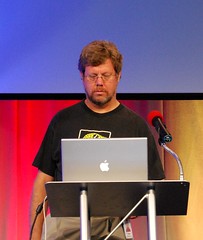
Comment to Guido's post "The History of Python: Adding Support for User-defined Classes"
I like dictionaries/namespaces better than objects. For me, your accomplishment with Python's implementation of user classes is on a par with Linus's insight to base a DVCS on a "mere" filesystem that only tracks content based on cryptographic hashes. A single idea, very simple but not _too_ simple, implies everything else, to great success.

Guido Van RossumImage by palewire via Flickr

Computer science is too important to leave in the hands of people who are not implementors.
Reblog this post [with Zemanta]