Showing posts with label Wang Yangming. Show all posts

Monday, February 1, 2010

Personality: Nature or Nurture - Genetics < 50%, but Genetic Expression > 50%

Whatever knuckle-dragging racists consider genetics probably counts for less than 50% of your personality, but...

Example Manga ExpressionsImage by DML East Branch via Flickr
Lets consider a persons particular genetic expression of personality (personality features manifest in an individual, paying no mind to the massive variability if we only consider the genetic heritage of the parents). Now, considering this, we have something that has much more influence over personality than environment.
For example, the Big Five personality traits:

http://en.wikipedia.org/wiki/Big_Five_personality_traits

Quote: The Big five factors are Openness, Conscientiousness, Extroversion, Agreeableness, and Neuroticism (OCEAN, or CANOE if rearranged)

These seem to be set at conception, visible soon after birth, stable for your whole life, and resistance to long term change due to environment or intervention.

Also, Jonathan Haidt's five Moral Foundations: Care/Protection, Fairness, Loyalty/Ingroup, Respect/Authority, Purity - also seems to be due to individual genetic expression, and resist change due to environment or intervention.

http://en.wikipedia.org/wiki/Jonathan_Haidt

[ nice TED video by Haidt: http://www.ted.com/talks/jonathan_haidt_on_the_moral_mind.html ]

These other things, to me, seem to be true:
  • It is a good thing to believe that you have the ability, with work, to positively change your repertoire of moral thoughts and moral actions. And most people have this belief (thank goodness).
  • Over the time scale of 10 to 15 years, with daily work, a person can positively change the repertoire of moral thoughts and moral actions. (Most Americans can only conceive of time scales of months, at most. Bad Times if you actually wish to improve yourself morally. Please consider daily work toward a longer time horizon goal.)

  • Herma of Zeno of Citium. Cast in Pushkin museu...Image via Wikipedia
    There is no lack of Good Info on positively changing the your repertoire of moral thoughts and moral actions, over the time scale of 10 to 15 years. Start with the Stoics and the Neo-Confucian thinker Wang Yangming, take seriously the writings of the Epicureans, the Cynics, the Buddhists, and the Taoists to foster some philosophic perspective. If Jesus floats your boat, he'z a good'n too.
After Personality and Moral Foundations, there is IQ. IQ counts as a distant third to personality and moral foundations in a human.

OK, now for fun, I will figure out where I sit with regards to the Big Five Personality traits, and Haidt's Five Moral Foundations:

Openness - I am more inventive/curious, less cautious/conservative

Conscientiousness - more spontaneous/careless, less efficient/organized

Extroversion - more shy/withdrawn, less outgoing/energetic

Agreeableness - more suspicious/antagonistic/outspoken, less friendly/compassionate


neurotics not-so-anonymousImage by Malingering via Flickr
Neuroticism - more sensitive/depressed/anxious, less secure/confident
For the Moral Foundations, I will state my goal, and what I am willing to risk to secure that goal.

Care - moral emotion towards people being taken care of - risking burdening the most capable to provide care for the most vulnerable, risking a loss of prosperity, and risking losing a cherished way of life or standard of living

Fairness - moral emotion towards strict fairness - even to the point of handicapping the most privileged to avoid the possibility of unfairness, risking a loss of prosperity, and risking losing a cherished way of life or standard of living.

Loyalty - moral emotion to not exclude the out-group, - even to the point of denying the most privileged the freedom to forming a self-perpetuating in-group, risking a loss of prosperity, and risking losing a cherished way of life or standard of living.

Respect - moral emotion to never let tradition or authority stand in the way of a moral goal, even to the point of mocking or harassing privileged tradition or authority, risking losing a cherished way of life or standard of living.

Purity - moral emotion to never let the desire for purity to stand in the way of a moral goal, even to the point of purposely & spitefully soiling or desecrating a thing or a place, risking losing a cherished way of life or standard of living.

Twice the SweetnessImage by Mish Mish via Flickr
Lastly...
The only place where I might push back is with Agreeableness - I am often quiet nasty, but I have a strong streak of Sweetness. It pains me to think someone nearby might be suffering emotionally, and I owe them to go more than halfway to let them know that it is not hopeless and to validate their grief and validate their potential to shed that grief. Even if I am just setting myself up to be taken advantage of, it is worth it to take that chance, for what is right.

An actual 13th century picture of the Devil.Image via Wikipedia
And, I am not particularly impressed with my ability to put moral concerns before my own comfort. If I had to pick the most contemptible thing about me, it is that I often put my own comfort over my own moral concerns.
...

Hey, that worked out well. I never wrote that all out in one place before.
Reblog this post [with Zemanta]

Tuesday, January 26, 2010

Neuronarrative: Power Makes the Hypocrite Bolder and Smugger


hypocrisy, not hiporcrisy; hypocrite, not hipo...
The uncomfortable nexus of power and hypocrisy.  Uncomfortable for me.  Contemplating the shakiness of my position could help.

Neuronarrative: Power Makes the Hypocrite Bolder and Smugger: "
...

Five experiments followed in which researchers examined the impact of power on the moral hypocrisy of the participants. They found a consistent and alarming outcome: those assigned to the ‘high-power’ group repeatedly condemned moral failures of others while committing unethical acts themselves. In one experiment, high-power participants were asked for their positions on cheating and over-reporting travel expenses, both of which they flatly condemned. They and the low-power group were then asked to play a dice game alone, in a private cubicle, to win lottery tickets. The powerful reported significantly higher lottery winnings than the low-power group, even though both groups had the same odds of winning.

Researchers also examined the degree to which the powerful accept their transgressions versus those committed by others. Across the board, they found that people in the high-power group strongly condemned such things as cheating, under-reporting taxes and keeping stolen property, while finding ways to rationalize committing the same actions themselves.

Perhaps the most interesting part of this study addressed whether the nature of power affected the level of hypocrisy. When participants in high-power roles were separated into those with legitimate power versus those with ‘shaky’ power (in other words, a level of power the individual did not believe he or she merited), researchers found that the legitimate power group consistently displayed more hypocrisy. People in the shaky power group, in contrast, were actually harder on themselves, in a way similar to those in the low-power group. Researchers labeled this outcome “hypercrisy.”

...

Hypocrisy
...the study produced interesting results that provide yet more reasons to be skeptical of those in power with a taste for moralizing.

"

[Edit]

Very nice write-up in the Jan 21st 2010 Economist of this very study by Joris Lammers at Tilburg University, in the Netherlands, and Adam Galinsky at Northwestern University, in Illinois.

http://www.economist.com/sciencetechnology/displayStory.cfm?story_id=15328544


The Arch at Northwestern's Evanston campusImage via Wikipedia
( original study described at http://www.kellogg.northwestern.edu/News_Articles/2009/galinsky_research.aspx )

But the Economist article ends strangely:
[...] Hypercrisy might thus be a signal of submissiveness—one that is exaggerated in creatures that feel themselves to be in the wrong place in the hierarchy. By applying reverse privileges to themselves, they hope to escape punishment from the real dominants. Perhaps the lesson, then, is that corruption and hypocrisy are the price that societies pay for being led by alpha males (and, in some cases, alpha females). The alternative, though cleaner, is leadership by wimps.
The wording "leadership by wimps" was meant to be read with a "wink", but is indicative of flawed reasoning if one is concerned with a quality of how a competitive organization is managed.

(Firstly, the concept of "alpha males/alpha females" in biology rarely translates into human hierarchies.  "Alpha males" must *always* be vigilant to challenges from any aggressor at any time, with tragic consequences if the alpha male loses - his own offspring may be killed by the new alpha.  In human hierarchies, there are far too many safeguards to the incumbents to make the stakes high enough for those incumbents to earn the title "alpha".  It is pure puffery, in common usage.)

For this discussion, consider "hypocrisy" as "high ranking individuals held to a less rigorous moral standard, low ranking individuals held to a more rigorous moral standard".  Consider "hypercrisy" as the opposite - "high ranking individuals held to a more rigorous moral standard, low ranking individuals held to a less rigorous moral standard".  How will this play out between different competitive organization characterized by differing levels of "hypocrisy" and "hypercrisy"?


Bandage of Faith, 2009, 50x40, oil on canvas b...Image via Wikipedia
The stress of "hypocrisy" throughout an organization can lead individuals to defensively take on the attitude of cynicism.  Below the highest rankings, the organization is characterized by cynical workers.  These cynical workers will then offer only a fraction of their value to the organization.  And the organization will strain to compete.
On the other hand, "hypocrisy" can be a unspoken bonus to high performing individuals at the upper ranking of an organization.  This bonus can attract and retain the high performers, to the benefit of the organization as a whole.

Benefits to the high performers that stress the organization as a whole should attract a critical eye.  Better to choose a different compensation, to avoid an organization permeated by cracks of social-psychic stress.

"Hypercrisy" along with commensurate compensation of high performers would seem to be optimal.  How to do this?


Do this by fostering through the organization a spirit of:
  • High position carries the discipline of high moral rigor and consequence for transgressions
  • High position carries the discipline of awe and humility before the scope of the collective responsibility
  • High position carries the discipline of awareness of the possibility of a reversal of fortune, and the philosophic outlook that is consistent with high effectiveness in the face of grave risk
So...  Why the comment about "hypocrisy tolerated so rule by wimps avoided"?  Probably because The Economist caters to a Conservative audience, and Conservatives have a bug-a-boo about the charge of hypocrisy.


Himachal Pradesh 1999Image by Akira ASKR via Flickr
And it is a shame, about Modern So-Called Conservatism and Modern So-Called Progressivism.  The Self-Called Conservatives want elites to be shielded from the consequences of their own moral transgressions, and the Self-Called Progressives want the lower classes to be shielded from the consequences of their own moral transgressions.  It is a race to the bottom, and functioning society suffers.
A Neo-Confucianist in the mold of Wang Yangming would lead people from the power of his own elevated moral stature and discipline.  Shame for the degeneracy of our own time and place.

Reblog this post [with Zemanta]

Sunday, November 29, 2009

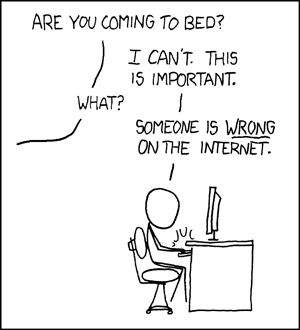
xkcd - Duty Calls; Can't sleep - Someone is _WRONG_ on the Internet

I was going to write about blog commenting on libertarian skepticism of human causes of global warming.


But, I will not whine about libertarian skepticism of human causes of global warming.


A traditional representation of The Vinegar Ta...Image via Wikipedia
I want to write about where I am led by considering Neo-Confucianist Wang Yangming and his conception of "Knowledge as Action".

http://en.wikipedia.org/wiki/Wang_Yangming#Knowledge_as_action

Denying Knowledge exists without corresponding action now, or corresponding actions in our current repertoire, or corresponding habits.

Hey, why would I comment on anything:

There are two conditions: either I am working on the problem, or not.

1) I am already working on the problem, to the best of my ability, commensurate with the resources available to me.  And I am commenting as part of that work, not wasting time on commenting that would be better spent on action.

2) No work - commenting to massage my ego

3) No work - commenting to signal my wonderfulness

4) No work - commenting to try to shame others

And not just commenting, also reading news about subjects that I am not really in a position to make a positive contribution.

There are two conditions: either I am working on the problem, or not.

1) I am already working on the problem, to the best of my ability, commensurate with the resources available to me.  And I am reading more as part of that work, not wasting time on reading that would be better spent on action.

2) No work - reading to massage my ego

3) No work - reading to regurgitate later, to signal my wonderfulness


Into the future but not without the pastImage by janusz l via Flickr
Also commenting and reading can be a form of time wasting and distraction and managing my mood (maybe indulging and nurturing a set of needy anxieties).

More opportunities for practice what I already know to be the best for me.  That may be why right-wingers can be so much more effective than left-wingers, because right-wingers will concentrate on mastering themselves just enough to "make their nut", where left-wingers may concentrate exclusively on external powers.
Reblog this post [with Zemanta]

Wednesday, November 25, 2009

Derek Sivers: Don't speak in future tense

How much of your pleasant conversation is feel-good promises of all the work you are planning to do? -- With no penalty for inaction because there is no true commitment towards action.

Derek Sivers - http://sivers.org/futuretense :
Images, from top, left to right: Downtown Los ...Image via Wikipedia
When I lived in Los Angeles, I noticed they have a strange speaking pattern.

Everyone speaks in future tense. (Or, more specifically, present-tense inaction, future-tense action.)

“This guy from EMI is interested and going to be presenting it to the VP.”

“We’re in talks to do a pilot for the fall.”

“I’m getting ready to work on some new material with a writer from Friends.”

Of course these are the things some people have to tell themselves to be hopeful when facing another day of challenges.

But of course nothing materializes. You never hear it mentioned again, and you politely don’t ask. (Surprising circumstances always foiled the certain event.)

I felt like wearing a t-shirt that says, “TELL ME WHEN IT’S ACTUALLY HAPPENING.”

So now when I hear a future-tense sentence, my ears shut down. I’ll say “cool!” and hope it helps, but I don’t believe a word.

Try noticing this in yourself and others for a week. Are you speaking more in future tense or present tense? Are they?

Wang Yangming (1472-1529), considered the most...Image via Wikipedia
This follows on the heels of reading Neo-Confucianist Wang Yangming [ http://en.wikipedia.org/wiki/Wang_Yangming ] and heavily discounting anything I call knowledge that isn't part of my current repertoire of action.

Wang Yangming (paraphrased from Wikipedia article): Any knowledge that had been gained then put into action was considered delusion or false.

Derek Sivers also links to his earlier column about how announcing your plans makes you less likely to do the work necessary to accomplish those plans.

Derek Sivers - http://sivers.org/zipit :
Tests done since 1933 show that people who talk about their intentions are less likely to make them happen.

Announcing your plans to others satisfies your self-identity just enough that you're less motivated to do the hard work needed.
...
Once you've told people of your intentions, it gives you a “premature sense of completeness.”

You have “identity symbols” in your brain that make your self-image. Since both actions and talk create symbols in your brain, talking satisfies the brain enough that it “neglects the pursuit of further symbols.”

Ajaccio - CorsicaImage by janusz l via Flickr
I want to remind myself not to over-do it.  My current M.O. is all about talking up the future and not doing anything in the present.  To move from one state of affairs to a better one will be a journey - feeling glum about one-step-back should be followed with two-steps-forward.  Remind myself: Most of the goals and tasks that can be straightforwardly accomplished are not really worth doing.

Might be valuable to phrase it as: "I will do X.  A poser would leave it there, as only words.  I would appreciate it if you could embarrass and shame me if I haven't accomplished sub-task Y (related to X) by such-and-such date.  If I fail to do it, I will make a public donation to a political cause I find repellent, as consequence for my inaction."
Reblog this post [with Zemanta]

Monday, November 23, 2009

Wang Yangming (Wang Shou-Jen)


Wang Yangming (1472-1529), considered the most...Image via Wikipedia
Listening to Audible.com _Confucius, Lao Tzu, and Chinese Philosophy_. Very interested in Wang Yangming. He felt very strongly that action and knowledge are inseparable.

The Internet Encyclopedia of Philosophy » Wang Yangming (Wang Shou-Jen): "
...[T]wo possibilities: first, that one can have knowledge without/prior to corresponding action; and second, that one can know what is the proper action, but still fail to act. Because of these two possibilities, the traditional position left open the possibility of separating knowledge and action, but called for the overcoming of this separation.
However, Wang denied both possibilities. These two denials constitute the essence of Wang’s theory of the unity of knowledge and action. First, according to Wang, it is only through simultaneous action that one can obtain knowledge: “If you want to know bitterness, you have to eat a bitter melon yourself.” Wang denied any other possible routes to obtain knowledge.
According to Wang, it is not possible for one to put something into practice after acquiring knowledge. This is because knowledge and action are unified already, from beginning to end. We cannot unify knowledge and action because they are already unified. Of course, Wang was aware of the claims that “there are people who know that parents should be served with filial piety and elder brothers with respect but cannot put these things into practice. This shows that knowledge and action are clearly two different things.” Wang’s answer was: “The knowledge and action you refer to are already separated by selfish desires and are no longer knowledge and action in their original state.” In other words, knowledge necessarily/automatically leads to action in its original state. We cannot have knowledge while preventing it from leading to action.
"


Wang believed that only through simultaneous action could one gain knowledge and denied all other ways of gaining it. To him, there was no way to use knowledge after gaining it because he believed that knowledge and action were unified as one. Any knowledge that had been gained then put into action was considered delusion or false.


Various styles of Chinese calligraphy.Image via Wikipedia
This is an important one for me, because my days are filled with knowledge acquired and never put into action. What a change if I never let it outside of the focus of my mind: turn knowledge into action, NOW, because otherwise that knowledge was false, it was simply delusion that lulled me into indulgent contemplation.
Reblog this post [with Zemanta]